

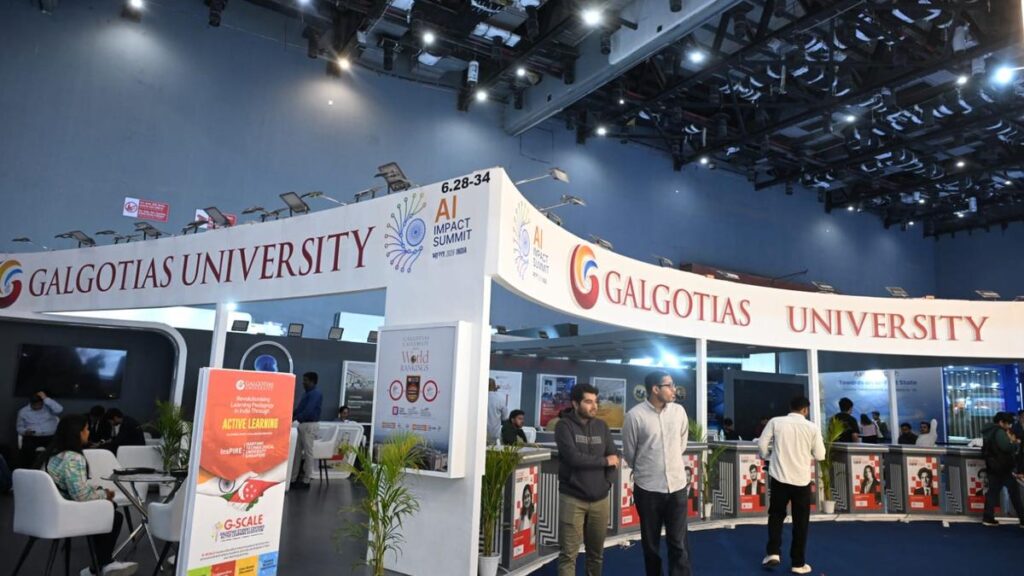
At the India AI Summit 2026 held in New Delhi, Galgotias University participated as an exhibitor, showcasing robotics and AI-enabled technologies at its pavilion. The event, positioned as a platform to highlight innovation and indigenous technological capability, attracted media coverage and public attention.
During the summit, a university representative speaking to a news channel stated that a robotic dog named “Orion” had been developed by the institution’s Centre of Excellence. The video clip circulated widely on social media shortly thereafter.
Online users and technology observers identified the robot as the Unitree Go2, a commercially available quadruped robot manufactured by China-based Unitree Robotics. The Go2 platform is widely used across research institutions, laboratories, and universities globally as a programmable robotics base for AI experimentation, mobility research, and applied robotics training.
As the controversy intensified, organisers asked the university to vacate its exhibition stall.
Galgotia’s press release response
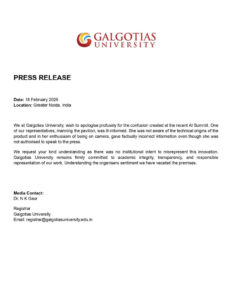
On 18 February 2026, Galgotias University issued an official press release from Greater Noida.
The statement apologised for the confusion created at the summit and clarified that:
-
The representative manning the pavilion was ill-informed about the technical origins of the product.
-
She was not authorised to speak to the press.
-
There was no institutional intent to misrepresent the innovation.
-
The university remains committed to academic integrity, transparency, and responsible representation of its work.
-
The premises were vacated in understanding of the organisers’ sentiment.
The university further indicated that robotic programming forms part of its effort to enable students to learn AI development using globally available tools and resources.
Government officials associated with the event emphasised that exhibitors should not present items as their own if they are not original creations. The organisers stated that they did not want controversy surrounding exhibits at the summit.
Understanding the technology context
The Unitree Go2 robot dog is not uncommon in academic environments. It is a modular, commercially available robotics platform designed for programming, experimentation, and AI-based applications such as perception modelling, autonomous navigation, and surveillance simulations.
Similarly, drone platforms like the Striker V3 ARF are often used as research or demonstration tools in robotics and aerospace programs.
Many institutions worldwide rely on imported hardware platforms to build student capability, develop software overlays, and conduct applied research. The core issue in this case did not arise from using imported equipment, but from the way the technology was described in a public forum.
Risk dimensions highlighted by the Galgotias incident
This episode presents several risk considerations relevant to universities, research institutions, and technology organisations.
-
Reputational risk
In a digitally connected environment, statements made at public events can quickly become amplified. Once questions around authenticity or attribution arise, reputational damage can spread rapidly, regardless of intent. -
Governance and communication risk
The press release acknowledged that the representative was not authorised to speak to the media. This raises questions about communication protocols at high-visibility events. Inadequate briefing, unclear spokesperson designation, and absence of media controls can create preventable exposure. -
Attribution and intellectual representation risk
There is an important distinction between developing original hardware, programming an existing platform, and showcasing purchased technology for learning purposes. Failure to clearly articulate this distinction may lead to perceived misrepresentation. -
Third-party and supply chain visibility risk
Institutions increasingly depend on global technology vendors. Transparent disclosure of third-party components and platforms is essential to avoid misunderstanding in public demonstrations. -
Event and compliance risk
Publicly supported innovation summits carry implicit expectations regarding authenticity and originality. Exhibitors may face heightened scrutiny from organisers, regulators, and peers. -
Crisis response risk
The issuance of a prompt apology and clarification demonstrates a reactive control mechanism. However, effective risk management requires preventive frameworks rather than corrective action alone.
Broader lessons
The case underscores that innovation showcases are governance events as much as they are marketing opportunities. Every public-facing interaction represents institutional accountability.
Universities and research institutions can draw key lessons:
-
Establish clear media interaction protocols before events.
-
Provide technical briefing documents to all representatives.
-
Clearly label the origin and nature of showcased technologies.
-
Integrate reputational risk into enterprise risk management frameworks.
-
Conduct pre-event risk assessments for high-visibility forums.
You can now take a free risk skill assessment here – to evaluate your current risk management readiness.
Strengthening risk readiness
Incidents such as the AI Summit controversy demonstrate that risk does not arise only from financial exposure or regulatory breaches. It often originates from communication gaps, attribution ambiguity, governance weaknesses, and inadequate internal controls.
For professionals across sectors, this raises an important question:
- Are you equipped to identify and manage emerging reputational, operational, and governance risks within your organisation?
To support structured risk capability development, we have launched a Risk Skills Assessment and Personalised Learning Pathway Creator for individuals working across industries.
The free assessment helps you evaluate your current risk management readiness and identifies areas where your skills may need strengthening. It also provides a customised learning pathway aligned to your role and sector.
You can take the Risk Skills Assessment to understand how prepared you are to tackle the risks that arise in your organisation.
Take the assessment through the link provided & reach out to us at info@rmaindia.org to train your teams in Risk Management. You can also start learning through our beginner level course- Foundations of Risk Management.