

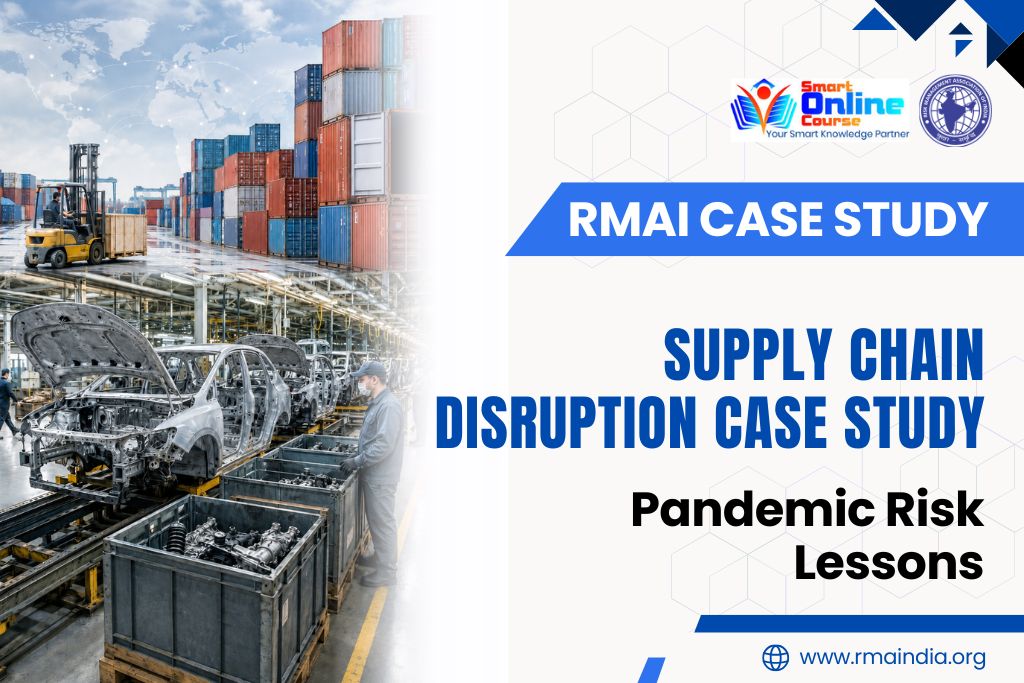
This case study explains how COVID-19 disrupted global supply chains.
Key insights:
- Heavy reliance on global suppliers increased risk
- Just-in-time inventory failed during disruptions
- Digital tools, diversification, and localization improved resilience
Executive Summary
The COVID-19 pandemic exposed significant vulnerabilities in global supply chains, causing widespread disruptions across industries. This case study focuses on a leading automotive manufacturer that faced severe challenges during the pandemic, including supply shortages, logistical bottlenecks, and delayed production schedules.
The disruption led to increased costs, reduced output, and strained relationships with suppliers and customers. The company responded by adopting a multi-faceted strategy, including diversification of suppliers, adoption of digital supply chain technologies, and a shift toward more localized production models.
This case study examines the root causes of the disruptions, the solutions implemented, and the outcomes achieved. It highlights the importance of resilience, flexibility, and digital transformation in mitigating supply chain risks and provides actionable recommendations for businesses to build more robust supply chains.
Introduction
Supply chain disruptions represent a major operational risk for global businesses, particularly those in industries with complex, tightly wound value chains like automotive, electronics, and aerospace. While the COVID-19 pandemic created unprecedented baseline challenges—including factory shutdowns, labor shortages, and sudden demand spikes—recent years have proved that volatility is the new normal. From the ongoing Red Sea shipping crisis forcing maritime trade to bypass the Suez Canal to climate-induced droughts in the Panama Canal, logistics networks remain under constant pressure.
This case study examines a leading automotive manufacturer that relied heavily on global suppliers and lean Just-in-Time (JIT) inventory practices. When the pandemic hit, the company faced a catastrophic halt in the supply of critical components like semiconductors, triggering immediate production delays and severe financial losses. The urgent task was to stabilize operations, minimize downtime, and engineer a long-term strategy to withstand future geopolitical and environmental shocks.
What is Supply Chain Disruption?
Supply chain disruption refers to any event that interrupts the normal flow of goods, services, or information within a supply chain.
Common causes include:
- Natural disasters
- Pandemics
- Supplier failures
- Transportation delays
- Demand fluctuations
Disruptions lead to delays, increased costs, and operational inefficiencies.
Definition of Key Terms
1. Supply Chain Disruption: Any event that interrupts the normal flow of goods, services, or information in a supply chain.
2. Just-in-Time (JIT): An inventory management strategy where materials are ordered and received only as needed for production, minimizing inventory costs.
3. Resilience: The ability of a supply chain to recover quickly from disruptions and adapt to changing conditions.
4. Digital Supply Chain: The use of technology to enhance visibility, efficiency, and decision-making across the supply chain.
5. Localization: The strategy of sourcing and producing goods closer to end markets to reduce dependency on global supply chains.
Why Supply Chain Disruptions Occurred During COVID-19
The pandemic caused disruptions due to:
- Factory shutdowns
- Labor shortages
- Transportation bottlenecks
- Semiconductor shortages
- Sudden demand shifts
Global interdependence amplified the impact.
JIT vs Buffer Inventory (Key Comparison)
| Aspect | Just-in-Time (JIT) | Buffer Inventory |
| Inventory Level | Low | Moderate/High |
| Cost | Low holding cost | Higher cost |
| Risk | High disruption risk | Lower disruption risk |
| Flexibility | Limited | High |
Global vs Local Supply Chains
| Aspect | Global Supply Chain | Localized Supply Chain |
| Cost | Lower | Higher |
| Risk | High dependency | Lower dependency |
| Speed | Slower | Faster |
| Resilience | Low | High |
The Problem
Challenges Faced by the Company:
-
Severe Component Shortages: Shutdowns of primary tier-1 suppliers in Asia caused immediate shortages of specialized parts, most notably semiconductors, stalling assembly lines.
-
Logistical and Transit Bottlenecks: Port congestion, container shortages, and restricted air cargo capacity delayed arrivals and caused a 15–30% spike in logistics costs.
-
Extreme Demand Volatility: Wild swings in customer purchasing habits made legacy data obsolete, leaving demand forecasting systems highly inaccurate.
-
Single-Source Dependencies: Relying heavily on a limited number of global suppliers for critical components created a single point of failure.
-
Cascading Downstream Halts: The inability to secure minor parts delayed entire vehicle shipments, eroding revenue and damaging dealer and customer satisfaction. (Note: This risk remains highly relevant today, as seen in late-2025 when a cyber incident forced automotive giants like Jaguar Land Rover to temporarily halt production).
The Solution
To address these challenges, the company implemented a comprehensive set of measures:
1. Broad Diversification of Suppliers
-
Identified, audited, and onboarded alternative suppliers across different geographic regions to break geographic monopolies.
-
Formed partnerships with regional suppliers to ensure secondary sourcing options with much shorter lead times.
2. Acceleration of Digital Supply Chain Tools
-
Deployed IoT sensors and real-time tracking systems to establish full transparency over intransit inventory and port delays.
-
Integrated Artificial Intelligence (AI) and machine learning platforms to process real-time market data, improving demand forecasting and risk sensing.
-
Utilized blockchain technology to map tier-2 and tier-3 supplier networks, ensuring complete traceability and compliance verification.
3. Strategic Shifts Toward Localization (Nearshoring)
-
Transitioned the assembly of critical sub-systems closer to core consumer markets, reducing exposure to volatile ocean freight lanes like those impacted by the Red Sea crisis.
4. Adoption of Hybrid Inventory Models
-
Abandoned strict JIT in favor of a hybrid approach, intentionally maintaining strategic safety stock (“buffer inventory”) for high-risk, critical components.
-
Established regional fulfillment hubs to safeguard production continuity against sudden transportation or border closures.
The Results
Quantitative Outcomes:
1. Reduced Production Downtime: Production downtime decreased by 50% within six months of implementing the new strategies.
2. Cost Savings: The adoption of digital supply chain technologies reduced logistics costs by 15%.
3. Faster Recovery: Time to recover from disruptions was reduced from 12 weeks to 6 weeks due to improved resilience measures.
4. Improved Supplier Base: The number of active suppliers increased by 30%, enhancing flexibility and reducing dependency on single sources.
Qualitative Outcomes:
1. Enhanced Visibility: Real-time tracking and AI-driven analytics improved decision-making and reduced uncertainty.
2. Increased Customer Satisfaction: On-time delivery rates improved, restoring customer confidence in the company’s reliability.
3. Stronger Relationships: Collaborative efforts with suppliers fostered mutual trust and long-term partnerships.
Real-World Business Impact
Supply chain disruptions can lead to:
- 15–30% increase in logistics costs
- Production delays
- Revenue loss
- Customer dissatisfaction
Resilient supply chains are a competitive advantage.
Limitations and Challenges
While highly successful, the transition highlighted several trade-offs:
-
Substantial Initial Capital Expenditure: Upfront investments in digital twins, AI platforms, and onboarding new suppliers required significant budget allocation.
-
Increased Management Complexity: Overseeing a highly diversified, multi-regional supplier network demanded rigorous governance and internal communication.
-
Inescapable Global Interdependencies: Complete self-sufficiency proved impossible; specialized, raw materials and advanced electronics still required cross-border trade.
Conclusion
The pandemic, followed by ongoing geopolitical and climate friction, permanently disrupted the era of static, low-cost supply chain design. This case study demonstrates how a leading automotive manufacturer successfully insulated itself from chaos by trading pure cost-minimization for dynamic resilience, localized sourcing, and digital transparency.
Building an adaptive supply network requires continuous investment, scenario stress-testing, and a willingness to move past legacy inventory models. In an increasingly unpredictable global environment, supply chain resilience is no longer just an operational checkbox—it is a core competitive advantage.
What You Learn from This Case Study
This case study helps you understand:
- How disruptions impact global supply chains
- Why supplier diversification is critical
- How digital technologies improve visibility
- How localization reduces risk
- How inventory strategies affect resilience
Discussion: Major Problems Summarized
1. Global Dependencies: Reliance on international suppliers increased vulnerability to disruptions.
2. Transportation Delays: Logistical challenges caused significant delays and higher costs.
3. Unpredictable Demand: Fluctuations in demand complicated production planning and inventory management.
4. Supply Chain Visibility: Lack of real-time data hindered effective decision-making during the crisis.
Recommendations / Key Learnings and Takeaways
-
Dismantle Single-Source Dependencies: Implement dual or multi-sourcing strategies across distinct geographic zones to prevent regional lockdowns from crippling production.
-
Embed Connected Intelligence: Treat trade visibility as a priority. Invest in cloud-based ERP systems, AI forecasting tools, and IoT tracking to detect and mitigate disruptions before they hit.
-
Balance Efficiency with Agility: Shift from strict JIT models to a hybrid approach that secures safety stock for critical, long-lead components.
-
Embrace Regionalization: Move manufacturing and critical warehousing closer to consumer bases (nearshoring) to mitigate long-distance maritime risks.
-
Conduct Regular Stress-Testing: Implement simulation models and scenario planning to evaluate how your supply network handles port strikes, cyber incidents, or extreme weather events.
Key Lessons for Businesses
- Diversify suppliers across regions
- Invest in digital supply chain tools
- Maintain safety stock for critical components
- Build strong supplier relationships
- Use scenario planning and stress testing
Practical Applications
This case study is useful for:
- Supply chain managers
- Risk management professionals
- Operations and logistics teams
- Business leaders managing global operations
- Students studying supply chain and operations
Frequently Asked Questions
1. What is a supply chain disruption?
It is an event—ranging from natural disasters to geopolitical conflicts—that interrupts the regular flow of raw materials, information, or finished goods within a supply network.
2. Why did Just-in-Time (JIT) inventory fail during recent global crises?
JIT relies on predictable, uninterrupted logistics. When global manufacturing centers shut down and ports congested simultaneously, companies without buffer inventory immediately ran out of parts.
3. How does localization or nearshoring reduce supply chain risk?
Sourcing closer to home shortens transit routes, eliminates exposure to complex ocean freight choke points, and allows companies to react faster to sudden changes in market demand.
4. What technologies are most effective for improving supply chain resilience?
Artificial Intelligence (for predictive demand and risk sensing), IoT tracking devices (for real-time shipment visibility), and cloud-integrated ERP systems (to break down organizational data silos).
References
1. Chopra, S., & Meindl, P. (2023). Supply Chain Management: Strategy, Planning, and Operation. Pearson.
2. World Economic Forum. (2023). The Resilient Supply Chain Report.
3. Deloitte Insights. (2024). Digital Supply Chains: The Future of Resilience.
