


Governance, Risk, and Compliance (GRC) functions are under pressure like never before. Regulatory expectations are growing, risks are becoming more interconnected, and manual processes simply cannot keep pace with digital complexity. In this environment, AI in GRC is emerging as a decisive enabler to help organizations enhance oversight, accelerate risk detection, and streamline compliance activities.
But the real question is: How can organizations practically implement AI in GRC to strengthen risk governance and improve decision-making?
This blog outlines the real applications, benefits, challenges, and implementation steps for using AI in GRC – designed specifically for Indian risk leaders and compliance professionals.
Why AI in GRC Matters Today
Traditional GRC frameworks rely heavily on manual monitoring, periodic reviews, and retrospective analysis. Unfortunately, today’s risks, including cyber threats, third-party failures, AI model risks, and regulatory changes, evolve in real time.
AI introduces three major capabilities that reshape GRC:
Continuous Monitoring Instead of Periodic Review
AI systems can analyze data streams like logs, transactions, vendor performance, user behavior, continuously, offering early signals of emerging risks.
Pattern Recognition at Scale
AI can identify anomalies that humans might miss, such as subtle fraud indicators or shifts in risk posture across business units.
Automation of Low-Value, High-Volume Tasks
Evidence collection, policy mapping, control testing, and compliance tracking can be automated, reducing operational fatigue and freeing teams for higher-order work.
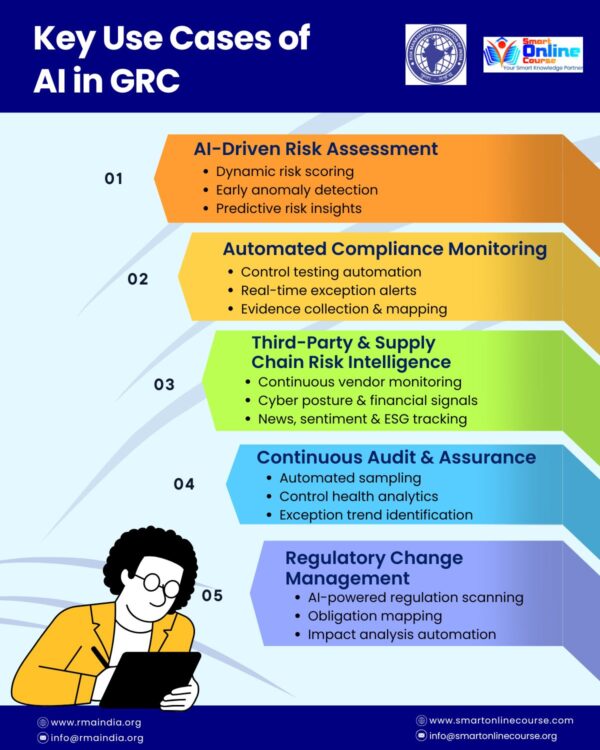
Key Use Cases of AI in GRC
AI-Driven Risk Assessment
AI enhances traditional risk assessment by analyzing data from multiple systems and generating dynamic risk scores. Some examples include:
- Predictive models for credit, operational, or compliance risk
- AI-assisted fraud detection
- Early detection of operational anomalies
This moves the organization from static to adaptive risk assessments.
Regulatory Change Management
AI can scan regulatory databases, extract relevant updates, map obligations to policies, and alert teams automatically. Key benefits are:
- Faster impact analysis
- Reduced manual review effort
- Lower risk of non-compliance due to oversight
This is especially relevant in India, where regulatory updates are frequent and sector-specific.
Automated Compliance Monitoring
AI can automatically check compliance against controls, identify control gaps, monitor evidence, and detect exceptions. This helps organizations:
- Improve audit readiness
- Ensure consistent control testing
- Reduce compliance fatigue across teams
Third-Party and Supply Chain Risk Monitoring
AI tools can track vendors using:
- Credit signals
- Cybersecurity indicators
- News sentiment
- Operational performance metrics
- ESG exposures
This provides a live picture of a vendor’s risk posture without waiting for annual assessments.
Strengthening Cyber & Data Governance
AI plays a decisive role in cybersecurity-aligned GRC functions:
- Detecting abnormal user behavior
- Identifying data leakage patterns
- Monitoring privileged access
- Mapping data assets for compliance
As Indian companies adopt cloud-first models, AI-led cyber governance becomes critical.
AI for Audit & Assurance
AI enhances internal audit by:
- Automating sample selection
- Performing continuous control testing
- Analyzing exceptions
- Supporting root-cause identification
This helps audit teams shift from detection to prevention.
Benefits of Implementing AI in GRC
Faster Decision-Making
AI dashboards and predictive insights give boards and risk leaders clearer visibility into risk exposure.
Improved Accuracy & Reduced Human Error
Automated workflows reduce inconsistencies caused by manual processes.
Lower Operational Cost of Risk
Automation of controls, evidence collection, and compliance significantly reduces GRC workload.
Scalable Governance
AI allows organizations to scale their oversight as business grows without proportionally increasing risk staff.
Stronger Risk Culture
Real-time insights empower employees and leadership to take early corrective actions.
A Practical Roadmap for Implementing AI in GRC
Step 1: Identify High-Impact Use Cases
Start with areas that consume the most manual effort, such as control testing or vendor monitoring.
Step 2: Assess Data Readiness
Ensure data sources are integrated, accessible, and standardized for AI consumption.
Step 3: Build an AI Governance Framework
Define:
- Model ownership
- Usage rules
- Ethics and bias checks
- Audit trails
Step 4: Implement in Phases
Pilot → Validate → Scale.
Avoid organization-wide deployments at the start.
Step 5: Upskill GRC Teams
Train teams to interpret AI insights, validate results, and adopt new workflows.
Step 6: Ensure Human Oversight
Establish clear boundaries for:
- What AI can automate
- What decisions must remain human-led
Step 7: Monitor & Continuously Improve
AI models evolve. Therefore, governance, testing, and calibration must be ongoing.
Challenges & Risks to Consider
Quality of Data
AI models depend on clean, reliable, structured data. Poor data leads to weak insights.
Explainability & Transparency
Regulators increasingly expect explainability for AI-driven decisions. GRC teams must ensure transparency in:
- Risk scoring
- Model outcomes
- Exception handling
Over-Reliance on Automation
AI assists decisions but it does not replace governance judgement. Human oversight remains essential.
Regulatory & Ethical Risks
AI implementations must adhere to emerging guidelines on:
- Data privacy
- Bias mitigation
- Auditability
- AI governance policies
The Future of AI in GRC
The future of GRC is connected, predictive, and real-time. As Indian organizations mature digitally, AI will become central in:
- Enterprise risk integration
- Regulatory compliance automation
- Predictive operational resilience
- ESG reporting
- Board-level risk decisions
The organizations that adopt AI early, not just as a tool, but as a governance enabler, will lead the next wave of risk transformation.
For more details and structured learning, please explore our Fraud Risk Management Course.
Master GRC
AI is no longer a future concept for GRC – it is a practical enabler that strengthens governance, enhances risk visibility, and reduces compliance effort. As risks become more dynamic, organizations that adopt AI-driven GRC frameworks will be better equipped to anticipate issues, respond faster, and build long-term resilience.
To accelerate your GRC transformation and stay ahead of emerging risks, explore more insights, resources, and professional programs offered by Smart Online Course, in collaboration with the Risk Management Association of India (RMAI).
Enroll Now!