


Risk management is no longer confined to registers, controls, or compliance checklists. Across industries, regulators and boards are increasingly emphasizing risk management culture as the real determinant of how effectively risks are identified, assessed, and managed. Organizations with strong frameworks but weak culture often fail during crises, while those with embedded risk awareness demonstrate resilience even under severe stress.
Risk management culture refers to the shared values, beliefs, and behaviors that shape how people across the organization perceive and respond to risk. It influences everyday decisions, escalation practices, accountability, and ethical conduct. Without the right culture, even the most sophisticated risk frameworks remain superficial.
Also Read: How to Build a Senior Risk Management Career?
Why Risk Management Culture Matters More Than Ever
The operating environment today is defined by interconnected risks such as financial volatility, cyber threats, regulatory scrutiny, operational disruptions, and reputational exposure. These risks cannot be managed effectively through policies alone. They require people at every level to act responsibly, question assumptions, and take ownership of risk outcomes.
A strong risk management culture enables organizations to:
- Identify emerging risks early through open communication
- Encourage responsible risk-taking aligned with strategy
- Prevent unethical practices and control failures
- Improve decision quality across business functions
- Strengthen regulatory trust and stakeholder confidence
Conversely, poor risk culture often manifests as delayed reporting, blame-shifting, excessive risk-taking, or risk avoidance that stifles growth.
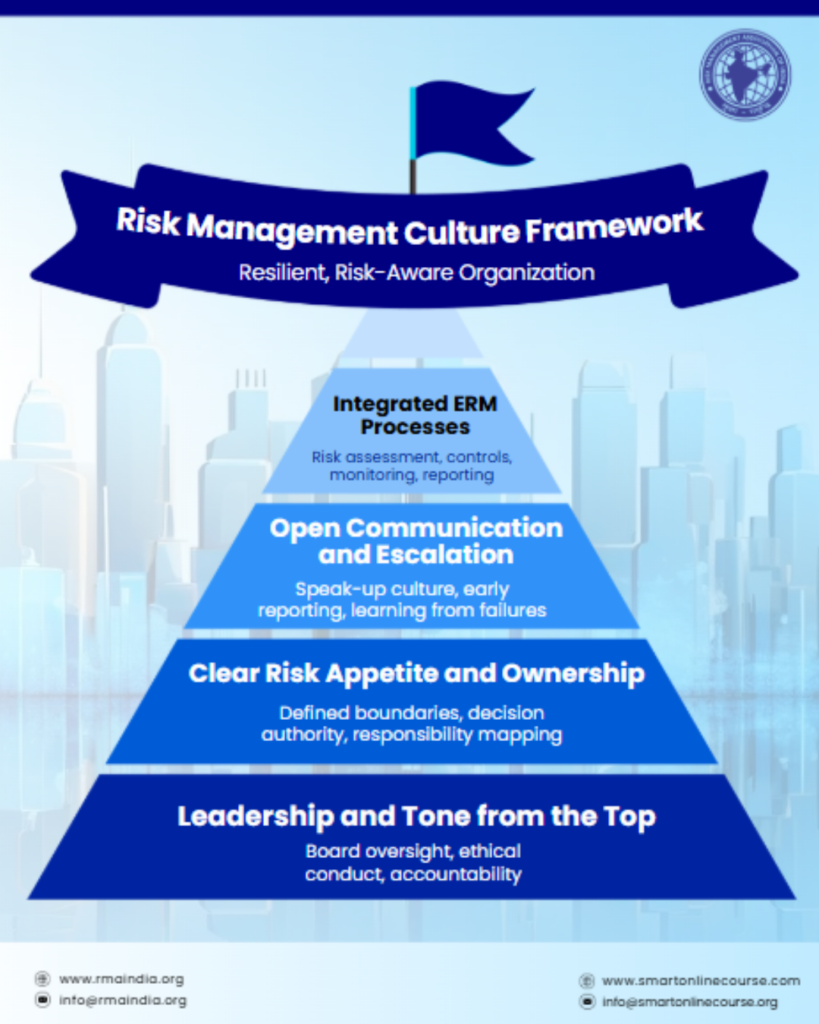
Key Elements of an Effective Risk Management Culture
Leadership Commitment and Tone from the Top
Culture is shaped first by leadership behavior. Boards and senior management must consistently demonstrate that risk considerations are integral to strategy and performance. When leaders prioritize short-term gains over risk discipline, that message quickly cascades through the organization.
Effective leadership sets clear expectations around risk appetite, ethical conduct, and accountability, while reinforcing that risk management is a shared responsibility rather than a compliance burden.
Clear Risk Appetite and Ownership
Risk management culture strengthens when employees understand how much risk is acceptable and who owns which risks. Clearly articulated risk appetite statements translate strategic intent into practical boundaries for decision-making.
Ownership must be defined not only at senior levels but across operational teams, ensuring accountability is embedded where risks actually arise.
Open Communication and Escalation
Organizations with mature risk cultures encourage employees to speak up without fear of retaliation. Near misses, control weaknesses, and emerging threats must be reported early and addressed constructively.
Silencing bad news or discouraging escalation is one of the fastest ways to undermine risk management culture and amplify losses.
Integrating Risk Management Culture with Enterprise Risk Management
Risk management culture should not operate in isolation from enterprise risk management (ERM). Instead, it must reinforce ERM processes such as risk identification, assessment, monitoring, and reporting.
When culture and ERM are aligned:
- Risk assessments reflect realistic behaviors rather than theoretical assumptions
- Controls are followed because they make sense, not because they are mandated
- Risk indicators trigger timely management action
- Strategic decisions consider downside risks and resilience, not just returns
Organizations that embed culture into ERM move beyond compliance-driven models toward value-based risk management.
To build these capabilities systematically, professionals need a structured understanding of how culture, governance, and risk frameworks interact.
The Risk Management Culture course by RMAI, delivered through Smart Online Course, is designed to help risk professionals and leaders translate cultural principles into measurable practices across their organizations.
Measuring and Monitoring Risk Culture
Although culture is often seen as intangible, it can be assessed and monitored through structured mechanisms. These include employee surveys, risk event analysis, audit observations, behavioral indicators, and management reviews.
Key questions organizations should regularly ask include:
- Are employees comfortable raising risk concerns?
- Do incentives encourage excessive risk-taking?
- Are lessons from past failures actively incorporated?
- Is risk ownership clearly understood across teams?
Monitoring these indicators helps leadership identify cultural gaps before they evolve into systemic failures.
Also Read: Risk Management Lessons from 2025 to Carry into 2026
The Role of Training in Strengthening Risk Culture
Training plays a critical role in shaping risk management culture, particularly in organizations with diverse functions and geographies. Formal learning ensures consistent understanding of risk concepts, regulatory expectations, and behavioral standards.
Effective risk culture training goes beyond theory. It connects real-world scenarios, governance structures, and decision-making frameworks, enabling professionals to apply risk principles in daily operations.
How to Go From Risk Management Frameworks to Mindsets
Risk management culture is not built through policies alone. It is shaped through leadership behavior, accountability, communication, and continuous learning. Organizations that invest in culture create an environment where risk awareness becomes instinctive rather than enforced.
For risk professionals, compliance leaders, and senior managers seeking to strengthen this foundation, structured learning is essential.
The Risk Management Culture course offered by RMAI through Smart Online Course provides practical insights into building, assessing, and sustaining a strong risk culture aligned with governance and regulatory expectations.
Learn more and enroll here: Online Certificate Course in Risk Management Culture