

Internal audit in banking is not just about checking compliance-it is about identifying control gaps, validating risk management practices, and strengthening governance across the organisation. Weak audit execution, poor documentation, and unclear observations often reduce the impact of audit functions.
This 7-hour practical course on Internal Audit in Banking equips professionals with the capability to plan, execute, and report audits with strong documentation, defensible sampling, and high-quality observations.
The course covers the complete audit lifecycle including planning, scoping, fieldwork, control testing, reporting, and follow-up. Participants learn how to conduct structured walkthroughs, apply sampling discipline, perform test of controls, and build audit-ready working papers.
It also focuses on drafting clear, risk-linked audit observations, classifying severity appropriately, and linking control failures to business impact. Common recurring audit issues such as cash exceptions, KYC gaps, loan documentation lapses, and reconciliation issues are analysed in detail.
Using real banking case studies and practical audit tools, the course builds the ability to execute audits effectively, strengthen control environments, and support governance and regulatory expectations .
Why this Course?
Many audit functions struggle with inconsistent workpapers, weak sampling justification, unclear observations, and poor linkage between control gaps and impact. As a result, audit reports fail to drive meaningful corrective action.
Without structured audit execution, evidence-based documentation, and strong observation quality, audit effectiveness is compromised.
What You’ll Learn
- Internal audit lifecycle: planning, fieldwork, reporting and follow-up
- Types of audits in banking: internal, concurrent, revenue and inspection
- Risk-based audit planning and scoping discipline
- Walkthrough techniques and control identification
- Sampling discipline and justification logic
- Test of controls execution and deviation identification
- Audit evidence documentation and working paper standards
- Drafting clear, risk-linked audit observations
- Severity classification and audit issue tracking
- Identifying recurring audit issues and strengthening control oversight
Key Details
Duration: 7 Hours
Format: Online | Self Paced | 100% Flexible & Accessible Anytime
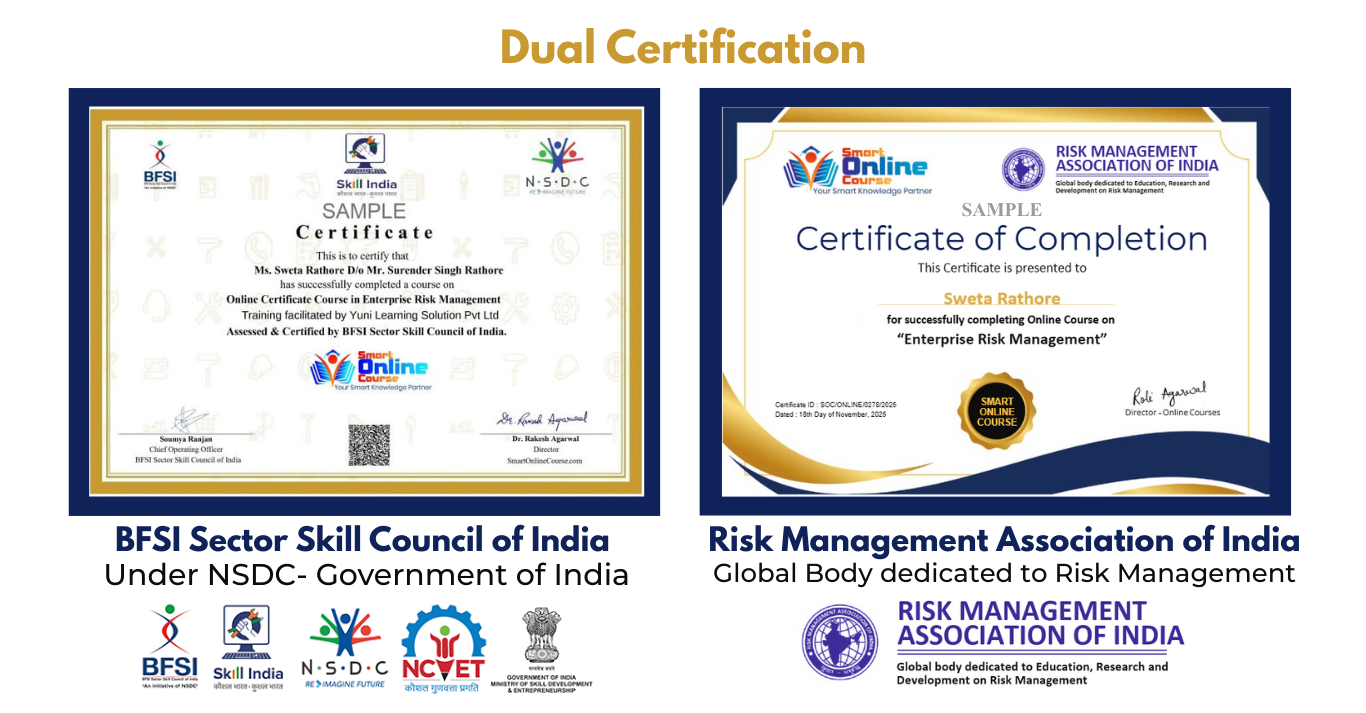
Dual Certification: Issued by Risk Management Association of India, Smart Online Course + BFSI Sector Skill Council of India
Get the complete training program details which includes:
- Career benefits and practical applications of the course
- Complete program details, eligibility, and enrollment information
Who Should Enroll
- Internal audit and concurrent audit professionals
- Branch inspection and audit teams
- Risk and control testing teams
- Compliance and governance professionals
- Banking professionals preparing for audit roles
Accelerate your growth with Dual Certification
Why this course is unique
Focuses on practical audit execution, not just theory
Strong emphasis on evidence-based documentation and defensibility
Covers end-to-end audit lifecycle in banking context
Improves observation quality and impact clarity
Designed for real-world audit and regulatory environments
FAQs
1. What is internal audit in banking?
Internal audit in banking is an independent review process that evaluates a bank’s internal controls, risk management practices, and regulatory compliance. It helps identify weaknesses and improve operational efficiency. Internal auditors provide assurance to management and the board. This makes internal audit essential for strong governance.
2. Why is internal audit important?
Internal audit helps detect control gaps, operational risks, and compliance issues before they become major problems. It strengthens governance and improves business processes. Effective audits also support regulatory compliance and risk management. This makes it a critical function in every bank.
3. Is this course suitable for beginners?
Yes, this course is designed for beginners as well as experienced professionals. It starts with the fundamentals of internal audit and gradually covers practical audit techniques. No prior audit experience is required. This ensures an easy and structured learning experience.
4. What practical skills will I gain?
You will learn how to plan audits, conduct walkthroughs, perform sampling and control testing, and prepare audit working papers. The course also covers drafting audit observations and classifying their severity. These practical skills are directly applicable in banking audit roles.
5. Will this course help in career growth?
Yes, internal audit professionals are in high demand across banks, NBFCs, and financial institutions. Strong audit and control assessment skills improve your employability and career prospects. This course enhances your professional profile. It also strengthens your industry credibility.
6. Do I need prior audit experience?
No, prior audit experience is not mandatory. The course explains concepts in a simple and structured manner. However, professionals in banking, finance, or compliance may find it especially relevant. It is suitable for learners at different career stages.
7. What certification will I receive?
You will receive a Dual Certification from SmartOnline in association with RMAI, aligned with the BFSI Sector Skill Council of India. The certification validates your knowledge of internal audit practices. It enhances your professional credibility. Employers recognize it as proof of your skills.
8. Is there any exam or assessment?
Yes, a final assessment is included within the course. There is no separate external examination required. The assessment helps reinforce your understanding of key concepts. It ensures effective learning outcomes.
9. How long will I have access to the course?
You will have access to the course for 120 days. This allows you to learn at your own pace and revisit topics whenever needed. The flexible learning period is ideal for working professionals. It helps you balance learning with your schedule.
10. Can I revisit the course content?
Yes, you can access and watch the course multiple times during the 120-day access period. Revisiting lessons helps reinforce important concepts and improve retention. This flexibility supports continuous learning. It also builds greater confidence in applying audit techniques.
11. Will this course help me perform real internal audits?
Yes, the course focuses on practical audit methodologies used in banking. It teaches planning, testing, documentation, and reporting through structured frameworks. While hands-on experience remains valuable, this course builds a strong practical foundation. It prepares you for real-world audit assignments.
12. Are audit documentation and working papers covered?
Yes, the course includes dedicated modules on audit evidence, working papers, and documentation standards. You will learn how to maintain high-quality audit records that support findings and regulatory expectations. These are essential skills for every internal auditor.
13. Is this course relevant across industries?
Yes, although the course focuses on banking, internal audit principles are applicable across financial services and many other industries. Risk assessment, internal controls, and governance are universal concepts. This broad applicability increases the value of the course.
14. What roles can benefit from this course?
This course is beneficial for Internal Auditors, Banking Operations Professionals, Compliance Officers, Risk Management Professionals, Finance Executives, Credit Officers, and aspiring audit professionals. It is also valuable for fresh graduates looking to enter the BFSI sector.
15. Why should I enroll in this course now?
Banks and financial institutions are strengthening internal controls and governance to meet increasing regulatory expectations. Skilled internal auditors are in greater demand than ever before. This course provides practical, job-relevant knowledge to help you stay competitive. Enrolling now can accelerate your career in banking and financial services.
Contact Us:
Website: www.smartonlinecourse.com
Email: info@smartonlinecourse.com
Phone: +91-8232083010 / 8697310275 / 9883398055
