
Online Course on Credit Documentation & Loan File Management in Banking

Credit Documentation and Loan File Quality Management

Credit risk does not start with default. It often begins with weak documentation, incomplete loan files, and poor tracking of sanction conditions. Even strong credit decisions can fail due to gaps in documentation, monitoring, and audit discipline.

This 6-hour practical course on Credit Documentation and Loan File Quality Management equips professionals with the ability to maintain structured, complete, and audit-ready loan files across the entire credit lifecycle.

The course explains the end-to-end loan documentation lifecycle from sanction to monitoring, including file structuring, sanction condition tracking, collateral documentation, disbursement controls, and post-disbursement monitoring records. Participants learn how to identify common documentation gaps such as missing agreements, incomplete collateral records, expired insurance, and weak monitoring notes.

It also focuses on checklist discipline, documentation validation, early warning signals, and linking documentation gaps with missed risk indicators. Strong emphasis is given to audit expectations and building defensible loan files.

Using real banking audit observations and practical case scenarios, the course builds the capability to reduce errors, improve documentation quality, and strengthen credit risk control .

Problem Statement

Many credit issues arise not due to poor lending decisions, but because of weak documentation discipline, incomplete loan files, and lack of structured monitoring. These gaps lead to audit observations, delayed risk detection, and enforcement challenges.

Without proper documentation and tracking, institutions face repeated audit findings, increased credit risk exposure, and regulatory scrutiny.

What You’ll Learn

  • End-to-end loan documentation lifecycle and file structure
  • Sanction documentation and condition tracking discipline
  • Collateral documentation, charge creation and insurance tracking
  • Pre-disbursement controls and checklist validation
  • Post-disbursement monitoring documentation and financial tracking
  • Early warning signals and their linkage with documentation gaps
  • Audit observations, file defensibility and regulatory expectations
  • Identifying and avoiding common documentation failures

Key Details 
Duration: 20
 Hours 
Format: 
Online | Self Paced | 100% Flexible & Accessible Anytime
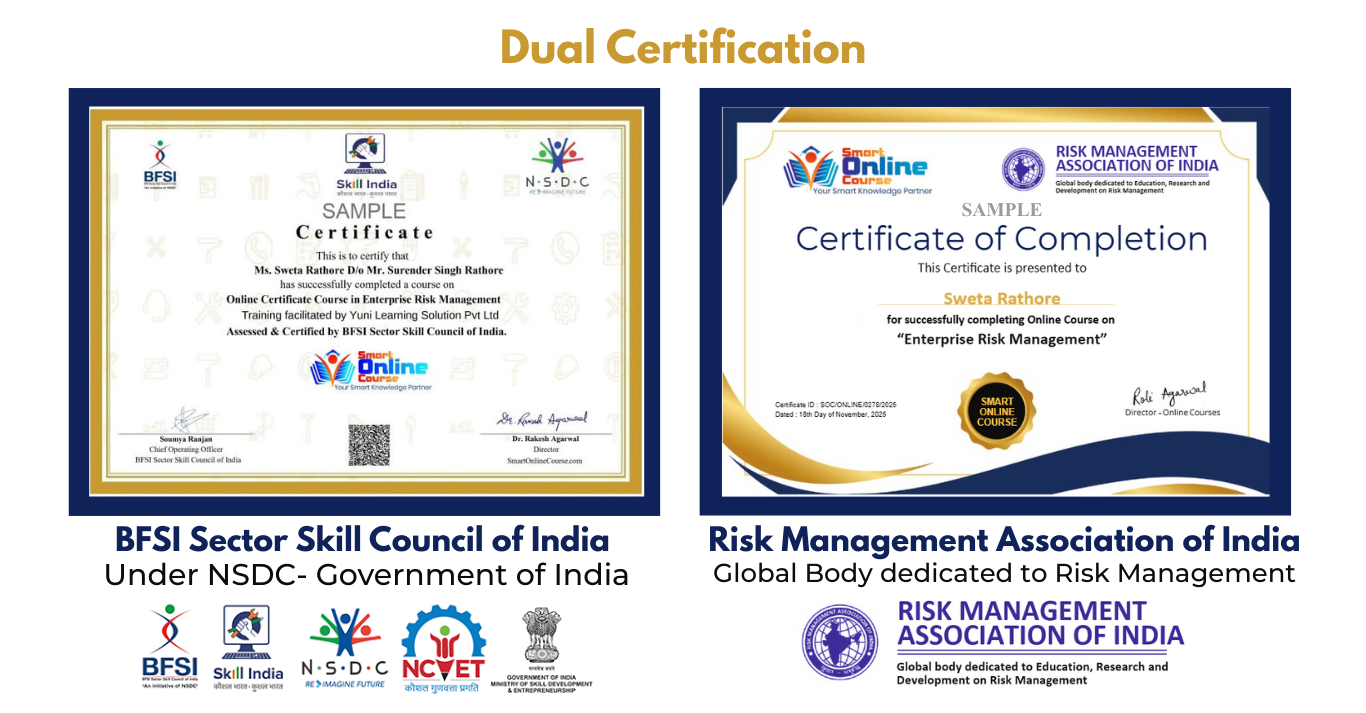
Dual Certification: Issued by Risk Management Association of India, Smart Online Course + BFSI Sector Skill Council of India

Study Guide Banner

Get the complete training program details which includes:

  • Career benefits and practical applications of the course
  • Complete program details, eligibility, and enrollment information


FILL THE FORM NOW!


Who Should Enroll

  • Credit processing and operations teams
  • Relationship managers and branch credit officers
  • SME and corporate lending teams
  • Internal audit and compliance professionals
  • Banking professionals involved in loan documentation

Course Format and Duration

  • 6 hours of structured expert-led learning
  • Real credit documentation case scenarios
  • Practical checklist and file structuring frameworks
  • Audit-focused documentation approaches
  • Certificate of Completion included

Why This Course Is Unique

  • Focuses on practical documentation gaps seen in audits
  • Covers entire credit lifecycle from sanction to monitoring
  • Builds audit-ready documentation and defensibility
  • Links documentation discipline with credit risk management
  • Designed specifically for banking credit operations

Skills You Will Gain

By completing this course, you will:

  • Understand loan documentation processes and credit workflows
  • Track sanction terms, conditions, and documentation requirements
  • Manage collateral, security creation, and documentation effectively
  • Apply disbursement controls and compliance procedures
  • Conduct post-disbursement monitoring and documentation reviews
  • Identify early warning signals through loan documentation and prepare loan files for audits and regulatory inspections
Credit
Credit

Modules Covered:

  • Introduction to Risk Management
  • Module 1 – Loan Documentation Lifecycle & File Structure
  • Module 2 – Sanction Documentation & Condition Tracking
  • Module 3 – Collateral, Security & Insurance Documentation
  • Module 4 – Disbursement Controls & Checklist Discipline
  • Module 5 – Post-Disbursement Monitoring & Documentation
  • Module 6 – Early Warning Signals & Documentation Linkage
  • Module 7 – Audit Observations & File Defensibility
  • Module 8 – Case Patterns & Practical Failure Scenarios

FAQs

1. What is credit documentation in banking?
Credit documentation refers to the collection and management of documents related to loans, including agreements, collateral, and compliance records. It ensures that loans are legally enforceable and properly recorded. Proper documentation reduces risks and supports recovery processes. Understanding this is essential for banking professionals.

2. Why is loan file management important?
Loan file management ensures that all required documents are complete, accurate, and easily accessible. Poor file management can lead to audit issues and legal risks. It also impacts the bank’s ability to recover loans. This makes it a critical function in banking operations.

3. Is this course suitable for beginners?
Yes, this course is designed to be beginner-friendly while also valuable for experienced professionals. It starts with foundational concepts and progresses to practical applications. No prior knowledge is required. This ensures a smooth learning experience.

4. What practical skills will I gain?
You will learn how to manage loan files, track sanction conditions, and handle collateral documentation. The course also covers disbursement controls and audit preparation. This ensures you gain actionable insights. These skills are directly applicable in banking roles.

5. Will this course help in career growth?
Yes, credit documentation is a key function in banking. Professionals with strong documentation skills are highly valued. This course enhances your profile and career opportunities. It also improves your performance in your current role.

6. Do I need prior banking experience?
No, prior banking experience is not required. The course is designed to simplify concepts for all learners. However, professionals in banking may find it especially relevant. The structured approach ensures accessibility.

7. What certification will I receive?
You will receive a Dual Certification from SmartOnline in association with RMAI, aligned with the BFSI Sector Skill Council of India. This certification validates your expertise. It enhances your professional credibility. Employers recognize it as proof of your skills.

8. Is there any exam or assessment?
Yes, a final test is included within the course itself. There is no separate external assessment required. This ensures convenience while maintaining quality. It also helps reinforce your learning.

9. How long will I have access to the course?
You will have access for 120 days. This allows you to learn at your own pace. You can revisit lessons anytime during this period. This flexibility is ideal for working professionals.

10. Can I revisit the course content?
Yes, you can watch the course multiple times during the access period. This helps reinforce your understanding. Revisiting lessons improves clarity. It ensures better retention and application.

11. Will this course help me handle real loan documentation?
Yes, the course includes practical frameworks and real-world scenarios. It prepares you to manage loan documentation effectively. While real-world situations may vary, you will gain strong foundational knowledge. This makes it highly valuable.

12. Are audit requirements covered in the course?
Yes, the course includes a dedicated focus on audit observations and file defensibility. This helps you understand how to prepare for audits. It ensures compliance with regulatory expectations. This knowledge is highly relevant.

13. Is this course relevant across banking roles?
Yes, the course is relevant for various banking roles including credit, operations, and audit. Documentation is a core function across departments. Understanding this gives you a competitive advantage. It ensures broad applicability.

14. What roles can benefit from this course?
This course is useful for roles in credit analysis, loan processing, compliance, and audit. It also benefits freshers entering banking. The skills are applicable across functions. This increases its value.

15. Why should I enroll in this course now?
Banks are focusing heavily on credit quality and compliance. Strong documentation skills are essential for success. This course provides practical and actionable insights. Enrolling now helps you stay ahead in your career.

Contact Us:

Website: www.smartonlinecourse.com
Email: info@smartonlinecourse.com
Phone: +91-8232083010 / 8697310275 / 9883398055

author avatar
RMA INDIA

Leave a Reply

This site uses Akismet to reduce spam. Learn how your comment data is processed.