


Artificial intelligence (AI) is redefining how insurance organizations assess risk, serve customers, and manage operations. What began as basic automation has evolved into advanced predictive models, real-time risk insights, and intelligent decision support systems. For insurers, AI in insurance is no longer a technology upgrade. It is a strategic capability with direct implications for underwriting quality, claims outcomes, regulatory compliance, and profitability.
As adoption accelerates, the focus is shifting from experimentation to governance, accountability, and sustainable value creation.
Also Read: Why AI Risk Management is Critical
AI in insurance: Why AI Matters to the Insurance Value Chain
Insurance is fundamentally a data-driven business. AI enhances this foundation by enabling insurers to process vast datasets with speed and precision that traditional methods cannot match.
Key drivers of AI adoption include:
- Increasing complexity of risk patterns
- Pressure to improve loss ratios and expense efficiency
- Rising customer expectations for faster and fairer outcomes
- Enhanced regulatory scrutiny on model risk and transparency
AI allows insurers to move from reactive analysis to proactive risk intelligence.
Also Read: AI Risk Management – How to Identify and Mitigate Bias Effectively
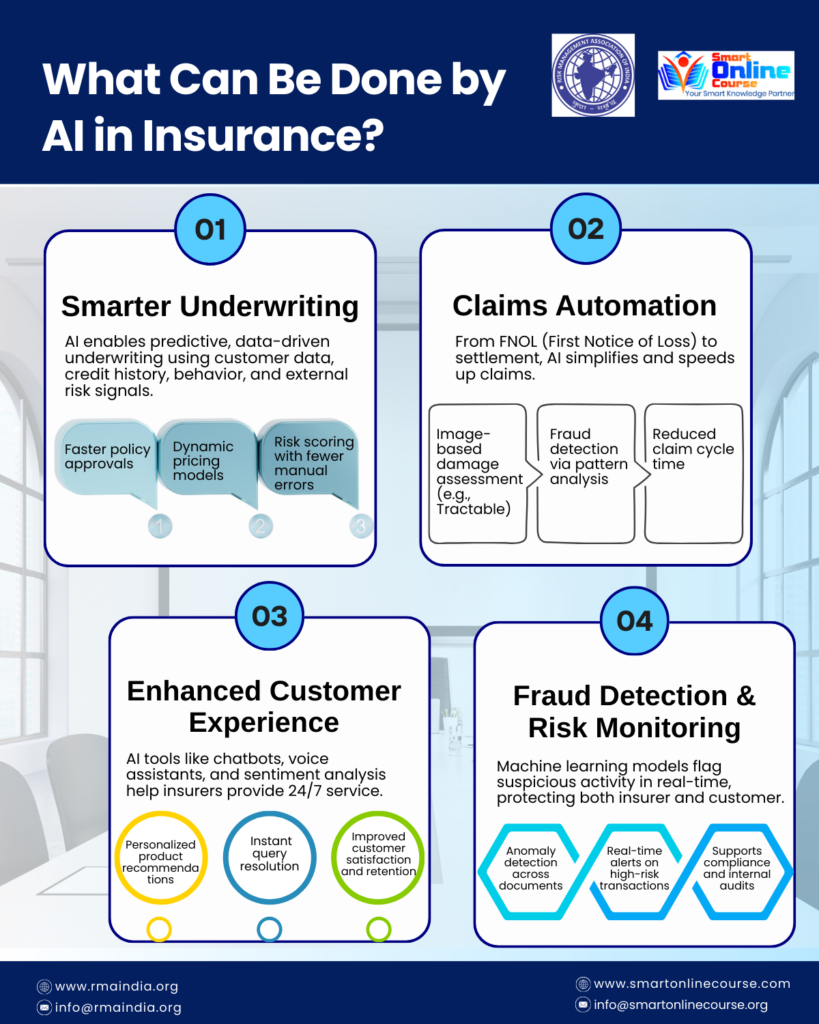
AI in underwriting and risk assessment
Underwriting has been one of the earliest beneficiaries of AI. Machine learning models analyze structured and unstructured data such as historical claims, customer behavior, external data sources, and risk indicators to improve pricing accuracy and risk selection.
Benefits include:
- More granular risk segmentation
- Faster underwriting decisions
- Reduced human bias through data-driven insights
- Improved portfolio management and profitability
However, governance remains critical. Underwriting models must be explainable, monitored for bias, and aligned with regulatory expectations.
Claims management and fraud detection
Claims processing is another area where AI is delivering measurable impact. Automation tools and predictive analytics help insurers:
- Triage claims based on severity and complexity
- Detect potential fraud using anomaly detection
- Accelerate settlement timelines
- Improve customer satisfaction through transparency and speed
AI-driven fraud detection systems analyze patterns across claims, networks, and behaviors, enabling early intervention while reducing false positives.
Customer engagement and personalization
AI-powered chatbots, recommendation engines, and behavioral analytics are improving customer interactions across the policy lifecycle. From onboarding to renewals, insurers can deliver personalized communication while reducing operational costs.
For insurers, the challenge lies in balancing automation with trust, data privacy, and ethical use of customer information.
AI, governance, and regulatory risk
As AI becomes embedded in core insurance functions, governance frameworks must evolve. Regulators increasingly expect insurers to demonstrate control over model risk, data quality, and decision accountability.
Key governance considerations include:
- Model validation and performance monitoring
- Transparency and explainability of AI decisions
- Data privacy and cybersecurity safeguards
- Clear accountability for automated outcomes
Risk and compliance teams play a central role in ensuring AI strengthens resilience rather than introducing new vulnerabilities.
AI in insurance: Building AI-ready insurance professionals
Technology alone does not deliver transformation. Insurers need professionals who understand both insurance fundamentals and advanced analytics. This includes the ability to interpret AI outputs, challenge models, and integrate insights into strategic decision-making.
AI literacy is quickly becoming a core competency for underwriters, claims leaders, risk managers, and compliance professionals.
To build practical capability in AI-driven insurance, analytics, and risk governance, explore specialized programmes offered by RMAI through Smart Online Course. These programmes are designed to help insurance professionals apply AI responsibly and effectively across the insurance value chain.
Check Out Related Courses:
- Responsible AI Risk Management (NIST AI RMF)
- AI & Emerging Technologies in Banking
- Artificial Intelligence in Insurance
- Risk Management for Artificial Intelligence
Related Articles:
| AI in GRC |