


The events and failures of 2025 reinforced critical risk management lessons for organizations. Risks are no longer isolated, slow-developing, or confined to individual functions. They are interconnected, data-intensive, and capable of escalating rapidly into enterprise-level disruptions.
Across insurance, financial services, manufacturing, and technology-driven sectors, losses and regulatory actions revealed common weaknesses. Most failures did not stem from unknown risks. They resulted from outdated risk frameworks, fragmented governance, and insufficient professional capability.
As organizations prepare for 2026, the focus must move from reactive risk response to institutionalized risk intelligence. The lessons from 2025 offer a clear roadmap.
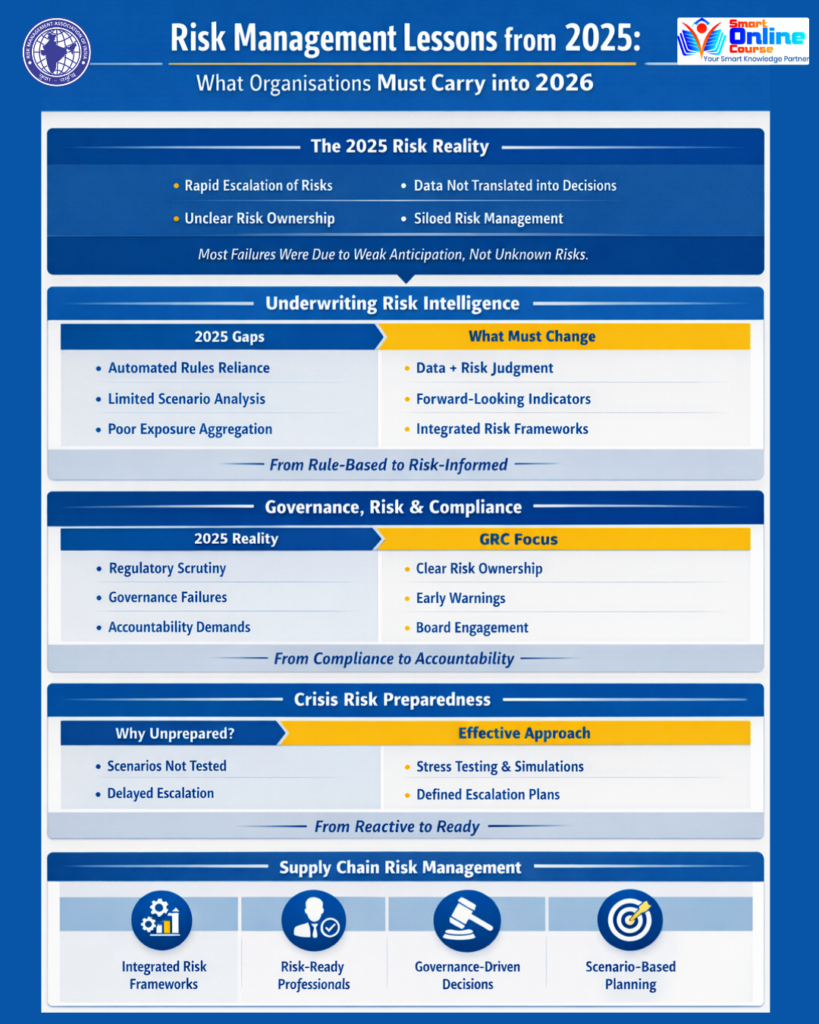
Insurance Underwriting Skills: From Rules to Risk Intelligence
Why Underwriting is Becoming More Risk-Focused
Underwriting in 2025 continued its shift toward data-driven decision-making. Advanced analytics, automated rules, and alternative data sources became central to underwriting operations. However, the year also demonstrated that data alone does not ensure better risk outcomes.
Many insurers experienced volatility because Insurance Underwriting decisions were overly reliant on historical data patterns without sufficient forward-looking risk assessment. Climate variability, cyber exposure, behavioral risk, and regulatory changes increasingly influenced loss ratios but were not consistently embedded into underwriting logic.
Common Underwriting Mistakes Observed in 2025
Several recurring gaps became evident:
- Overdependence on automated underwriting without human risk judgment
- Limited scenario analysis for emerging and correlated risks
- Inadequate exposure aggregation across portfolios
These issues highlighted the need for underwriters who understand both analytics and enterprise risk dynamics.
This shift is driving demand for structured, risk-focused underwriting capability building, where professionals are trained to interpret data through a risk management lens rather than apply rules mechanically.
Governance, Risk and Compliance: Moving Beyond Checklist Compliance
Rising Regulatory Expectations in India
Regulatory actions in 2025 underscored a clear message. Compliance failures are increasingly treated as governance failures. Regulators are focusing not only on what went wrong, but on who was responsible and whether risks were identified and escalated in time.
In India, scrutiny intensified around internal controls, disclosures, data governance, related-party transactions, and board oversight of risk.
Why GRC Roles are Expanding
Organizations that treated compliance as a standalone or post-facto activity struggled to respond effectively. In contrast, those with integrated GRC frameworks demonstrated stronger resilience.
The lesson from 2025 is that governance, risk, and compliance must operate as a unified system. Risk ownership must be clearly defined. Early warning indicators must reach decision-makers. Compliance professionals must understand business risk implications, not just regulatory text.
This evolution is reshaping GRC roles, increasing the need for professionals with cross-functional risk expertise.
Crisis Risk Analysis: Learning from 2025 Failures
Why Organizations Failed to Anticipate Crises
Corporate and operational disruptions in 2025 shared similar characteristics. Risks were identified but deprioritized. Crisis risk scenarios were documented but not tested. Decision-makers were unfamiliar with escalation protocols.
Technology dependencies, cyber incidents, vendor failures, and liquidity pressures often combined to create cascading effects. In many cases, leadership teams underestimated the speed and scale at which these risks could materialize.
The Importance of Crisis Risk Frameworks
The lesson is not that crises are unpredictable. It is that crisis preparedness must be institutionalized.
Effective crisis risk analysis requires:
- Scenario-based stress testing
- Clear escalation and decision authority
- Regular simulations involving senior leadership
Without these elements, organizations remain exposed even when risks are known.
Supply Chain Risk Management: From Operational Issue to Board Agenda
Why Supply Chains Remain Structurally Fragile
Supply chain disruptions in 2025 went beyond delays and cost overruns. Concentration risk, geopolitical developments, climate-related disruptions, and regulatory constraints exposed deep structural vulnerabilities.
Many organizations lacked visibility into critical dependencies. Single-source suppliers, regional concentration, and technology reliance were insufficiently mapped and quantified.
Why Supply Chain Risk is Now a Board-Level Topic
Boards increasingly expect supply chain risk to be treated as an enterprise risk issue. This includes quantified exposure, scenario impact assessment, and alignment with financial and compliance risks.
Supply chain resilience is no longer an operational concern. It is central to organizational stability and strategic decision-making.
What Organizations Must Carry into 2026
The defining lesson from 2025 is clear. Risk management must evolve from documentation to decision enablement. Organizations must embed risk intelligence into underwriting, governance, crisis preparedness, and supply chain oversight.
This requires professionals who understand risk as a strategic discipline rather than a control function. Institutions such as Smart Online Course, in association with Risk Management Association of India (RMAI), contribute to this transition by strengthening professional capabilities across underwriting, enterprise risk, GRC, and crisis management, helping organizations and individuals build resilience for 2026 and beyond.
Click Here → Risk Management Courses