
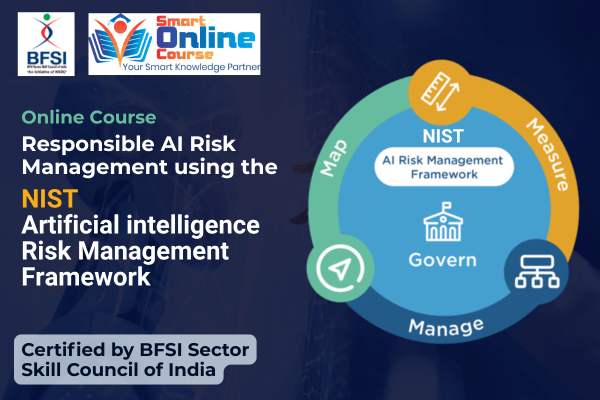
Online Certificate Course on Responsible Risk Management using NIST AI RMF

NIST AI RMF

NIST AI RMF: AI is transforming industries- but without responsible risk management, it can also amplify bias, harm, and non-compliance.

Smart Online Course, in partnership with the Risk Management Association of India (RMAI) offers Responsible AI Risk Management using the NIST AI RMF – a 9-hour professional certificate course that helps you build, audit, and govern AI systems aligned with global trust and safety standards.

Through 7 structured modules, this course demystifies the NIST AI Risk Management Framework (AI RMF)-covering principles, structure, and application through real-world case studies from banking, insurance, fintech, and HR analytics.

Learners gain the skills to assess bias, manage explainability, design mitigation plans, and align AI governance with international laws like the EU AI Act, OECD Principles, and India’s DPDP framework.

Also Read: NIST AI RMF Explained: Implementation, Training & Certification

❗ Problem Statement

Most organizations adopt AI without a clear governance roadmap, leading to reputational, ethical, and regulatory risks.

Compliance teams, risk professionals, and data scientists often work in silos—without a shared framework for managing AI accountability, transparency, and trust.

This course bridges that gap by translating the NIST AI RMF into a practical, hands-on implementation approach for professionals in BFSI, technology, and corporate governance sectors.

Key Details 
Duration:
9 Hours 
Format: 
Online | Self Paced | 100% Flexible & Accessible Anytime
Dual Certification: Issued by Risk Management Association of India, Smart Online Course + BFSI Sector Skill Council of India

Study Guide Banner

Get the complete training program details which includes:

  • Career benefits and practical applications of the course
  • Complete program details, eligibility, and enrollment information


FILL THE FORM NOW!


What You’ll Learn in NIST AI RMF

Understand the principles and structure of the NIST AI Risk Management Framework (MAP–MEASURE–MANAGE–GOVERN)

  • Identify and map AI risk contexts—from fairness and bias to privacy, explainability, and human oversight
  • Quantify and measure risks using scorecards, audits, and model cards
  • Develop and implement AI mitigation and response strategies aligned to organizational governance
  • Interpret and apply global regulations like the EU AI Act, OECD guidelines, and India’s DPDP Act
  • Explore real-world case studies across BFSI, insurance, and HR use cases
  • Learn to build AI governance checklists, risk registers, and bias detection frameworks
  • Gain access to NIST toolkits, templates, and open-source AI audit tools

Also Read: 6 Steps of NIST RMF Explained with Real-Life Examples

Who Should Enroll

  • Risk, compliance, and audit professionals in BFSI and technology sectors
  • AI & data governance teams seeking structured implementation frameworks
  • Policy, ethics, and L&D professionals responsible for AI oversight
  • Consultants and faculty in AI governance and corporate risk
  • MBA, data science, and law students aspiring to specialize in Responsible AI

NIST AI RMF Course Format & Duration

  • 9 hours of expert-led content (7 core modules + toolkit module)
  • 100% online and self-paced learning
  • Real-world case studies from banking, insurance, and corporate HR
  • Certificate of Completion included – jointly issued by RMAI and Smart Online Course
  • Includes downloadable resources—toolkits, glossaries, comparison charts, and audit checklists

Skills You Will Gain

By completing this course, you will:

  • Understand responsible AI principles and governance frameworks
  • Apply the NIST AI Risk Management Framework (AI RMF) in practical scenarios
  • Identify, map, and assess AI risks across the AI lifecycle
  • Measure, monitor, and quantify AI-related risks effectively
  • Implement AI risk mitigation, governance, and compliance strategies
  • Build trustworthy, ethical, and resilient AI systems aligned with global best practices

Accelerate your growth with Dual Certification

Dual Certification

Why This NIST AI RMF Course is Unique

  • Based entirely on the NIST AI Risk Management Framework (2023)
  • Integrates global regulatory alignment with practical implementation tools
  • Combines technical, ethical, and legal perspectives for cross-functional teams
  • Includes toolkits, templates, and case-based assignments
  • Ideal for professionals implementing Responsible AI and compliance frameworks

Modules Covered

  • Module 1 – Introduction to Responsible AI & the NIST AI Risk Management Framework (AI RMF)
  • Module 2 – Understanding the Core Structure and Functions of the NIST AI RMF
  • Module 3MAP Function: Defining AI Context, Risks & Use Cases
  • Module 4MEASURE Function: Assessing, Monitoring & Quantifying AI Risks
  • Module 5MANAGE Function: Risk Mitigation, Controls & Response Strategies
  • Module 6GOVERN Function: AI Governance, Oversight, Policies & Global Standards
  • Module 7 – Practical Industry Use Cases of the NIST AI RMF
  • Module 8 – AI Risk Toolkits, Templates, Glossary & Downloadable Resources

FAQs

1. What is the NIST AI Risk Management Framework (AI RMF)?
The NIST AI Risk Management Framework (AI RMF) is a globally recognized framework developed to help organizations identify, assess, manage, and govern risks associated with artificial intelligence systems. It promotes trustworthy, secure, and responsible AI throughout the AI lifecycle. The framework is built around four core functions—GOVERN, MAP, MEASURE, and MANAGE. Understanding the AI RMF is essential for responsible AI adoption.

2. Why is responsible AI important?
Responsible AI helps ensure that AI systems are fair, transparent, secure, reliable, and compliant with regulatory expectations. It minimizes risks such as bias, discrimination, privacy breaches, and unintended outcomes. Organizations that adopt responsible AI improve trust, accountability, and long-term business success. This makes it a critical capability in today’s AI-driven world.

3. Is this course suitable for beginners?
Yes, this course is suitable for beginners as well as professionals interested in AI governance and risk management. It explains the NIST AI RMF in a structured and practical manner before progressing to implementation strategies. No advanced programming knowledge is required. This makes the course accessible to learners from both technical and non-technical backgrounds.

4. What practical skills will I gain?
You will learn how to apply the NIST AI RMF, identify and assess AI risks, implement governance frameworks, measure AI-related risks, and develop mitigation strategies. The course also covers regulatory expectations and industry best practices. These skills can be applied in real-world AI governance initiatives.

5. Will this course help in career growth?
Yes, expertise in responsible AI and AI governance is becoming highly valuable across banking, insurance, healthcare, technology, consulting, and government sectors. Organizations are actively seeking professionals who understand AI risk management frameworks. This course strengthens your professional profile and enhances career opportunities.

6. Do I need technical knowledge to take this course?
No, deep technical knowledge is not required. The course explains AI governance and risk concepts in a practical and easy-to-understand manner. Professionals from risk management, compliance, audit, legal, business, and technology backgrounds can all benefit. The structured approach ensures accessibility for diverse learners.

7. What certification will I receive?
You will receive a Dual Certification from SmartOnline in association with RMAI, aligned with the BFSI Sector Skill Council of India. This certification validates your understanding of the NIST AI Risk Management Framework and responsible AI practices. It enhances your professional credibility and employability.

8. Is there any exam or assessment?
Yes, a final assessment is included within the course. There is no separate external examination required. The assessment helps reinforce your understanding of AI governance concepts and practical implementation strategies. It ensures effective learning outcomes.

9. How long will I have access to the course?
You will receive 120 days of access to the course. This allows you to learn at your own pace and revisit modules whenever required. The flexible access period is ideal for both students and working professionals.

10. Can I revisit the course content?
Yes, you can access the course multiple times during the 120-day access period. Revisiting the lessons helps strengthen your understanding of the NIST AI RMF, governance principles, and AI risk management practices. This improves knowledge retention and practical application.

11. Will this course help me implement AI governance frameworks?
Yes, the course provides a practical, step-by-step approach to implementing AI governance using the NIST AI RMF. You will learn how to establish governance structures, assess AI risks, develop controls, and monitor AI systems throughout their lifecycle. These skills are directly applicable in organizational AI initiatives.

12. Are industry use cases included?
Yes, the course includes practical use cases demonstrating how organizations apply the NIST AI RMF across industries. These examples help you understand real-world AI governance challenges and implementation strategies. This practical approach enhances learning and applicability.

13. Is this course relevant globally?
Yes, the NIST AI RMF is widely recognized as an international best-practice framework for AI risk management. The concepts covered are applicable across industries and jurisdictions, making the course valuable for professionals working in global organizations. This ensures broad international relevance.

14. What roles can benefit from this course?
This course is ideal for AI Governance Professionals, Risk Managers, Compliance Officers, Internal Auditors, Data Scientists, AI Product Managers, Technology Leaders, Cybersecurity Professionals, Consultants, and professionals working in banking, insurance, fintech, healthcare, and technology sectors.

15. Why should I enroll in this course now?
AI adoption is accelerating, while governments and regulators are introducing stronger AI governance requirements. Organizations need professionals who can implement responsible AI frameworks and manage AI-related risks effectively. This course provides practical, globally relevant skills that prepare you for the future of AI governance and responsible AI implementation.

Contact Details

For more information:

author avatar
RMAINDIA

Leave a Reply

This site uses Akismet to reduce spam. Learn how your comment data is processed.