

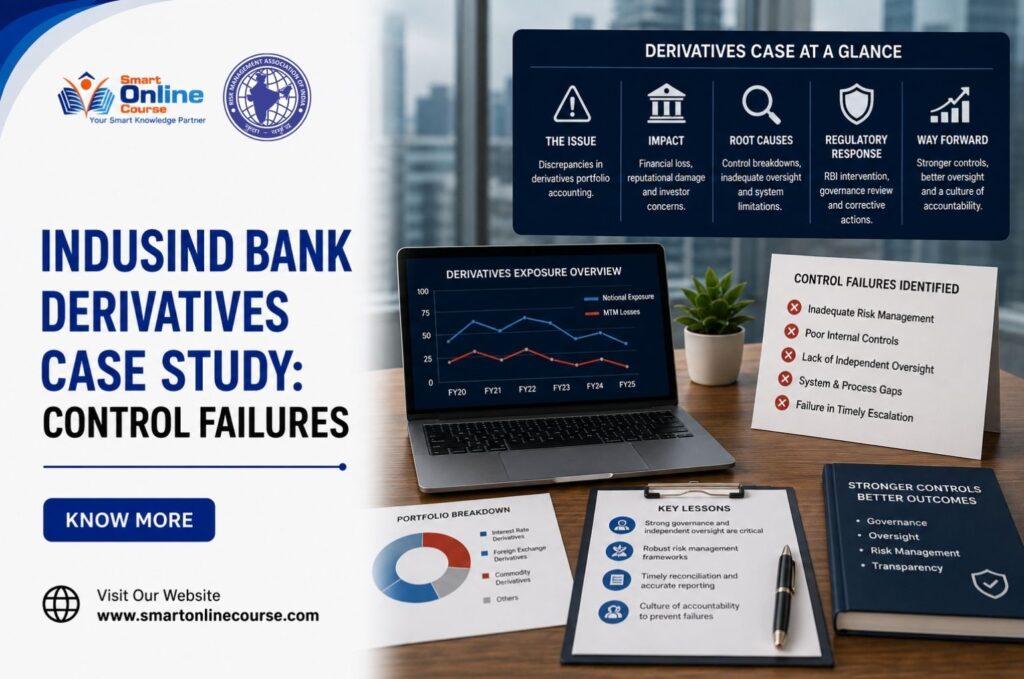
In March 2025, IndusInd Bank disclosed discrepancies in account balances associated with its derivatives portfolio. An initial internal review estimated an adverse effect equivalent to approximately 2.35% of the bank’s net worth at 31 December 2024. An independent review subsequently quantified the impact at ₹1,979 crore, or approximately 2.27% of net worth.
The bank recognised the effect in its financial results for the year ended 31 March 2025, including a reversal of approximately ₹1,960 crore from other income. Senior leadership changes followed, while the matter also attracted regulatory and investor scrutiny.
The case is not simply about a derivatives loss. It raises deeper questions about how internal transactions were accounted for, how balances were reconciled, when information became material, how exceptions were escalated and whether the board and its committees received sufficiently clear and timely information. It demonstrates that capital strength cannot compensate for weaknesses in valuation, financial reporting, audit trails and governance.
Background: why banks use internal derivative trades
Banks enter into foreign-exchange and interest-rate derivatives for customers, risk management, liquidity management and trading activities. A customer-facing transaction may create a currency or interest-rate exposure for the bank. That exposure may then be transferred internally from one desk or banking book to another before it is hedged externally.
These internal transactions do not create a new exposure for the bank as a consolidated entity. However, they still require consistent accounting because the two sides of an internal trade must correspond. The valuation method, recognition of income or loss and timing of entries should be aligned so that internal profits and losses offset appropriately at the entity level.
This creates several control requirements:
Both sides of every internal trade must be completely captured. The front office and back office must use consistent trade data. Valuations must be independently verified. Inter-desk and general-ledger balances must be regularly reconciled. Suspense accounts and aged entries must be investigated. Accounting policies must be reviewed whenever regulatory requirements change. Material differences must be escalated promptly.
If one side of an internal derivative is recognised differently from the corresponding side, income can appear in one part of the accounts without the offsetting effect being recognised correctly elsewhere. Over time, unresolved differences may accumulate into a material financial-reporting problem. Many of these control gaps sit squarely within the operational risk discipline; RMAI’s Operational Risk Management Guide sets out how institutions identify, assess and monitor exactly this kind of process and control breakdown.
What happened at IndusInd Bank?
On 10 March 2025, IndusInd Bank informed the stock exchanges that it had reviewed processes relating to “other asset” and “other liability” accounts in its derivatives portfolio. The review followed the implementation of the RBI’s Classification, Valuation and Operation of Investment Portfolio of Commercial Banks Directions, 2023, which became applicable from 1 April 2024.
The bank stated that it had identified discrepancies in the relevant account balances. Its internal assessment estimated an adverse impact of approximately 2.35% of its net worth as at 31 December 2024. It appointed an external agency to independently validate the assessment and said that the resultant impact would be reflected in its financial statements. IndusInd Bank’s 10 March 2025 disclosure.
On 15 April 2025, the bank announced the outcome of the independent review. The cumulative adverse accounting impact was assessed at ₹1,979 crore as at 30 June 2024. This represented approximately 2.27% of the bank’s net worth at 31 December 2024. The bank stated that it would account for the impact in its financial statements for FY 2024–25 and strengthen internal controls.
When announcing its annual results, the bank reported that it had reversed approximately ₹1,960 crore from other income in relation to the derivatives discrepancies. The difference between the ₹1,979 crore independent assessment and the approximately ₹1,960 crore recognised reversal reflects the distinction between the review’s quantified impact and the amount ultimately presented through the financial statements; these figures should not be treated as two separate losses. IndusInd Bank’s FY 2024–25 analyst-call transcript.
Verified timeline
| Date | Development |
|---|---|
| September 2023 | RBI issued revised directions on classification, valuation and operation of banks’ investment portfolios. |
| 1 April 2024 | The revised RBI directions became applicable. |
| 10 March 2025 | IndusInd Bank publicly disclosed discrepancies and estimated an impact of approximately 2.35% of net worth. |
| 15 April 2025 | The independent review quantified the adverse impact at ₹1,979 crore, or approximately 2.27% of net worth. |
| 29 April 2025 | Deputy CEO Arun Khurana resigned, referring to the developments concerning derivative accounting. |
| 30 April 2025 | Managing Director and CEO Sumant Kathpalia resigned and stated that he was taking moral responsibility. |
| 21 May 2025 | FY 2024–25 results reflected an approximately ₹1,960 crore reversal of other income relating to the discrepancies. |
| 28 May 2025 | SEBI issued an ex-parte interim order in separate insider-trading proceedings involving five individuals. |
The observations in SEBI’s May 2025 order were expressly preliminary and issued pending further investigation. They should not be described as final findings of wrongdoing. SEBI’s interim order.
Financial and organisational consequences
The immediate accounting consequence was the recognition of a substantial adjustment in FY 2024–25. The derivatives-related reversal contributed to pressure on reported profitability during a period when the bank was also dealing with stress in its microfinance portfolio and other accounting adjustments.
The wider consequences extended beyond the profit-and-loss account:
Investor confidence was affected by uncertainty over the size and origin of the discrepancy. The bank’s share price fell sharply after the initial disclosure. Rating attention intensified because internal-control weaknesses can affect profitability, capital and funding confidence. The Managing Director and CEO and the Deputy CEO resigned. The bank had to conduct independent accounting and forensic reviews. Regulators examined disclosure, governance and trading-related questions. Management had to reassure depositors and investors about liquidity and capital adequacy.
The episode therefore illustrates how an accounting-control failure can rapidly become a governance, leadership, disclosure and reputation event.
Risk and control-failure analysis
1. Accounting-policy risk
A derivatives transaction can produce different accounting outcomes depending on its purpose, classification and valuation methodology. Internal transactions require particular care because the economic exposure may cancel at the bank level while the accounting entries remain distributed across different books or units.
The central control question is whether the bank had one approved and consistently implemented accounting policy for internal derivative transactions. Whenever RBI directions or accounting guidance changes, management should complete an end-to-end impact assessment rather than treating implementation as a narrow compliance exercise.
2. Reconciliation risk
The discrepancy involved balances recorded under other assets and other liabilities. Such accounts require close monitoring because large, old or unexplained entries can hide incomplete settlements, mismatches or accounting errors.
An effective reconciliation process should establish:
Who owns each balance; Whether both sides of a transaction are recorded; How long unmatched entries have remained open; Whether manual adjustments are independently approved; When an exception becomes material; and Who can close an exception after remediation.
The persistence of a difference is often more significant than its initial size. Repeated unresolved breaks can indicate a structural weakness rather than an isolated processing error.
3. Independent valuation and model risk
Treasury desks may use models to calculate fair value, future cash flows and mark-to-market changes. Valuation should therefore be subject to independent price verification, model validation and periodic back-testing.
The control function must be independent of the desk whose performance is affected by the valuation. If the same business unit originates a trade, selects assumptions, calculates its value and explains reconciliation differences, effective challenge is weakened. RMAI’s Model Risk Management article, which reviews the RBI’s draft guidance on regulatory principles for model risk, offers a useful reference for how institutions are expected to govern exactly this kind of valuation and model dependency.
4. Governance and escalation risk
SEBI’s interim order referred to internal communications indicating that senior personnel were examining the financial impact before the March 2025 public disclosure. However, the order contained prima facie observations made during an ongoing proceeding. SEBI later corrected part of the order concerning the documentation through which an external firm had been engaged, clarifying an implication relating to board knowledge.
The wider governance lesson remains important: a material accounting concern must move through a clearly documented escalation route from the operating function to the CFO, risk and compliance functions, audit committee and board. RMAI’s banking governance case study on NPA management and stressed asset governance illustrates a comparable escalation and governance discipline applied to a different credit-lifecycle risk, and is a useful companion read for this analysis.
Management information should communicate:
The estimated range of financial impact; The period over which the discrepancy accumulated; The affected products and accounts; The reliability of the estimate; Any disagreement over accounting treatment; Regulatory and disclosure implications; and The remediation owner and deadline.
5. Disclosure and conduct risk
Information about a material accounting impact may constitute unpublished price-sensitive information. Once identified, the institution must control access, maintain insider records, restrict trading and assess whether public disclosure is required.
SEBI’s May 2025 proceedings concerned alleged trading while in possession of such information. Because those observations were interim, the case should not presume guilt. Nevertheless, it demonstrates that accounting investigations must immediately activate disclosure and insider-trading controls; they cannot be managed solely as finance-department reviews. RMAI’s Fraud Risk Management article examines a comparable real-life scenario of how internal control gaps around trust and oversight can turn into a broader conduct and disclosure failure.
What should boards and risk committees do differently?
Boards need exception-based reporting rather than broad assurances that systems are functioning. A derivatives-control dashboard should show unmatched trades, aged breaks, manual adjustments, unexplained other-asset balances, valuation differences and breaches of escalation deadlines.
Audit committees should also ask whether internal and statutory auditors have tested the economic substance of transactions, not merely whether entries agree with system reports. When an issue is large, old or difficult to explain, an independent review should be commissioned with clear authority to examine root cause, financial impact, responsibility and disclosure implications.
Responsibility must be divided across the three lines:
The treasury and finance functions should own accurate recording and daily controls. Risk and compliance should challenge valuation, limits, policy compliance and escalation. Internal audit should independently test the complete process and report directly to the audit committee.
Professionals looking to build this kind of structured, cross-functional risk capability can explore RMAI’s Risk Management Certificate Course, which covers the frameworks and practical tools referenced throughout this analysis.
Practical governance checklist
Financial institutions should consider the following questions:
Are internal derivative trades recorded symmetrically in all relevant books? Are valuation models independently validated and periodically reviewed? Are material prices and assumptions independently verified? Does finance review aged other-asset and other-liability balances? Are reconciliation breaks assigned to named owners with deadlines? Can management reconstruct the complete audit trail for every adjustment? Are regulatory changes subjected to end-to-end implementation testing? Are material accounting concerns promptly reported to the audit committee? Are insider lists and trading restrictions activated when sensitive issues emerge? Does remediation receive independent effectiveness testing before closure?
Key takeaways
The IndusInd Bank case demonstrates that derivatives risk is not confined to market movements. It also arises from accounting policy, valuation methodology, reconciliation, data integrity, manual intervention and governance.
The ₹1,979 crore assessed impact was material, but the deeper concern was that discrepancies could accumulate over time before being publicly resolved. Capital adequacy gave the bank resilience; it did not eliminate the need for reliable financial controls.
For boards, CROs, CFOs and auditors, the principal lesson is clear: complex transactions require simple accountability. Every material balance must have an owner, every valuation must face independent challenge, every exception must have an escalation deadline, and every price-sensitive issue must activate disclosure and conduct controls.
Risk professionals who want ongoing access to case studies, frameworks and peer discussion on issues like this one can learn more through RMAI Membership.
