

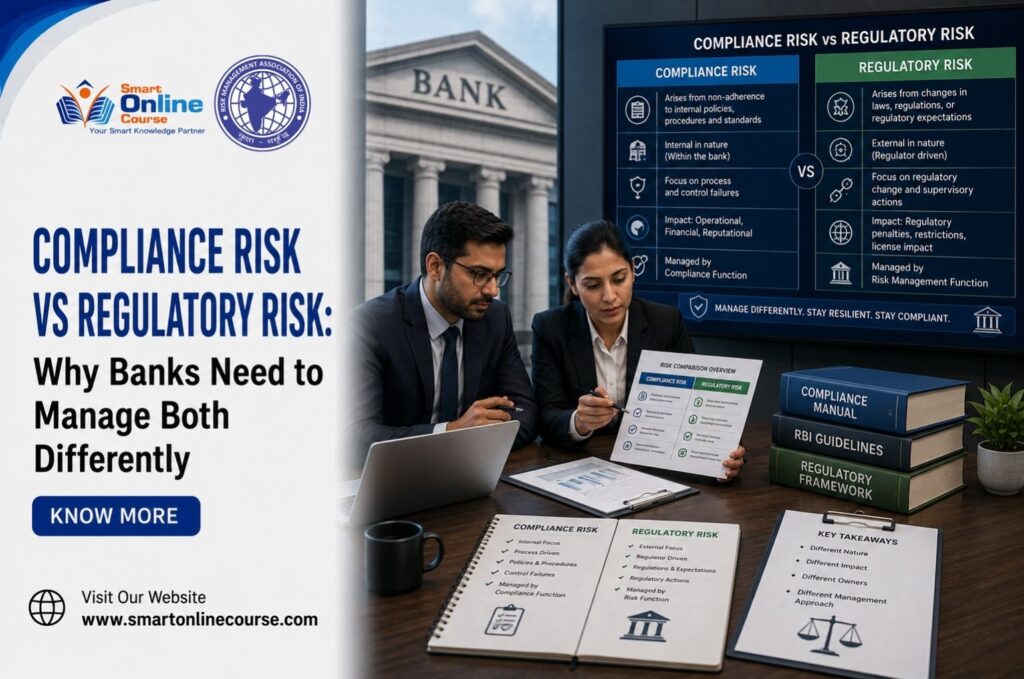
Inside most banks, compliance risk and regulatory risk are spoken about almost interchangeably, often sitting under the same team, the same policy document, and the same quarterly report to the board. This is a costly simplification. Compliance risk vs regulatory risk is not a matter of semantics, the two represent genuinely different sources of exposure, and treating them as one undifferentiated category leaves gaps that eventually surface as fines, supervisory action, or missed strategic risk.
Understanding the distinction, and building separate but connected management approaches for each, is becoming increasingly important as India’s regulatory environment grows more dynamic, with the RBI issuing frequent amendments, new directions, and evolving supervisory expectations across nearly every area of banking.
What Compliance Risk Actually Means
Compliance risk is the risk that arises when an institution fails to adhere to laws, regulations, internal policies, or codes of conduct that already apply to it. It is fundamentally about execution and adherence. A bank that misses a reporting deadline, fails to update its KYC documentation within required timelines, or does not properly implement an existing RBI direction is experiencing a compliance risk failure. The rule exists, is known, and the institution simply did not follow it correctly or on time.
Compliance risk tends to be operational in nature. It is managed through checklists, policy manuals, training programmes, internal controls, and monitoring systems designed to ensure that known obligations are met consistently. When compliance risk materialises, the root cause is usually a breakdown in process, training, systems, or internal discipline, rather than uncertainty about what the rule actually requires.
What Regulatory Risk Actually Means
Regulatory risk is a broader, more strategic category. It refers to the risk that changes in the regulatory environment itself, new laws, amended directions, shifting supervisory expectations, or entirely new frameworks, will materially affect an institution’s business model, capital position, cost structure, or competitive standing. Regulatory risk is not about failing to follow an existing rule, it is about being caught unprepared when the rules themselves change, or about not having anticipated the direction regulation was heading.
A bank that has fully complied with every existing capital adequacy requirement can still face significant regulatory risk if RBI introduces a new framework, such as the Expected Credit Loss provisioning regime, that requires a fundamental shift in how the institution measures and holds capital against credit risk. The institution was not doing anything wrong under the old rules, but the new rules create material exposure regardless. This is regulatory risk, and no amount of compliance discipline under the previous framework would have prevented it.
Why the Distinction Matters
Conflating compliance risk and regulatory risk leads to two common and costly mistakes. The first is under investing in regulatory horizon scanning, because a compliance heavy risk function that is focused entirely on adherence to existing rules may not have the mandate, resources, or forward looking orientation needed to track draft directions, consultation papers, global regulatory trends, and policy signals that indicate where regulation is heading. The second is treating regulatory change purely as a compliance implementation task, handed to the same team that manages day to day adherence, without the strategic, cross functional planning that major regulatory shifts actually require, spanning capital planning, technology investment, product design, and business model adjustments.
The Expected Credit Loss transition offers a clear illustration. Once finalised, implementing it correctly becomes a compliance risk matter, meeting deadlines, following prescribed methodologies, and reporting accurately. But anticipating that such a shift was coming, understanding its likely capital impact, and beginning preparation well before the final direction was issued, that is regulatory risk management, and it requires a fundamentally different kind of capability, one oriented towards interpretation, forecasting, and strategic planning rather than checklist adherence.
How Banks Should Manage Each Differently
Compliance risk management should focus on strong policy documentation, clear ownership of obligations across business units, robust monitoring and testing systems, staff training tied to specific regulatory requirements, and escalation processes for near misses or breaches. This is largely an execution and control discipline, best supported by dedicated compliance officers working closely with operational and business teams.
Regulatory risk management requires a different orientation entirely. It calls for structured horizon scanning of draft directions, consultation papers, and global regulatory trends, scenario planning around how emerging regulatory themes might affect capital, business models, and product strategy, and direct engagement with industry bodies and regulators during consultation periods to help shape outcomes rather than simply reacting to them. This work sits closer to strategic risk management and often needs senior sponsorship, since it involves decisions about resource allocation and business direction well before a rule is finalised.
Institutions that build genuinely separate, but well coordinated, capability for these two risk types tend to be far better positioned, meeting existing obligations reliably while also anticipating and preparing for what is coming next, rather than being caught reacting to both simultaneously.
Conclusion
Compliance risk and regulatory risk demand different skills, different time horizons, and different organisational responses. Banks that recognise this distinction, and build dedicated capability for each rather than treating them as one function, are better placed to stay both compliant today and prepared for tomorrow.
Build This Capability with RMAI
RMAI’s Online Certificate Course on Governance, Risk and Compliance (GRC) helps professionals build strong compliance execution capability alongside the governance structures needed to manage regulatory change strategically.
For teams that need to connect regulatory shifts to broader organisational risk planning, the Online Certificate Course in Enterprise Risk Management builds the integrated, forward looking risk thinking regulatory risk management requires.
Explore RMAI’s complete suite of risk management courses to build this capability further.
