

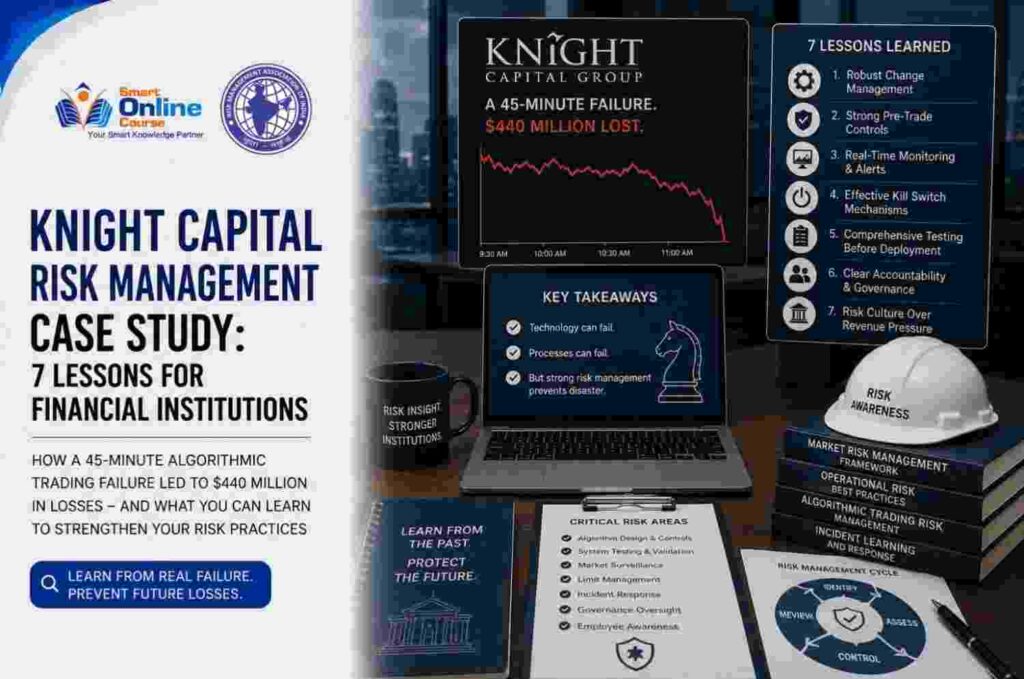
On August 1, 2012, Knight Capital Group, then one of the largest market makers in United States equities, lost more than 460 million dollars in roughly 45 minutes. The cause was not a market crash, a fraud, or a cyberattack. It was a defective software deployment combined with a piece of dormant code that had sat unused in the company’s systems for years. Within a single trading session, Knight Capital went from a stable, profitable market maker to a firm fighting for survival, ultimately rescued through an emergency 400 million dollar capital infusion and acquired by a rival less than a year later.
The case remains one of the most studied technology failures in financial markets history, and for good reason. According to the United States Securities and Exchange Commission’s own findings, the incident is a nearly complete case study in how technology risk, change management failure, and inadequate control design can combine to produce a capital crisis in less time than it takes to hold a single meeting. With SEBI’s current focus on measurable IT resilience for market infrastructure institutions, and RBI’s parallel emphasis on operational and technology risk governance for banks, the Knight Capital case offers lessons that remain directly relevant to Indian financial institutions today, more than a decade after the event itself.
What Actually Happened
The roots of the failure trace back to 2005, when Knight Capital had used a section of code, referred to internally as the Power Peg function, as part of an earlier order testing process. When that function was no longer needed, engineers moved a related section of code to an earlier point in the sequence within Knight’s automated equity router, known as SMARS. This effectively rendered the original Power Peg function defective and, critically, it was never removed from the production codebase. It simply sat there, dormant and unused, for seven years.
In late July 2012, Knight Capital prepared to participate in a new initiative from the New York Stock Exchange called the Retail Liquidity Program. This required deploying new code into the same router that contained the old, dormant Power Peg function. During deployment, the new code was not installed correctly across all of Knight’s servers. One technician manually deployed the new code to seven of eight servers used for order routing. The eighth server retained the old code, including the defective, dormant Power Peg function, without anyone at Knight realising the deployment was incomplete.
When markets opened on August 1, 2012, orders that were eligible for the new Retail Liquidity Program began arriving at all eight servers. On the seven correctly updated servers, everything worked as intended. On the eighth server, however, these orders triggered the old, defective Power Peg function, which began repeatedly buying and selling shares without any throttle or limit, unable to correctly recognise that its own orders had already been filled.
The 45 Minutes That Followed
While attempting to fill just 212 customer orders, Knight Capital’s malfunctioning router sent more than 4 million orders into the market. The firm executed over 4 million individual trades across 154 stocks, totalling more than 397 million shares, all within approximately 45 minutes. By the time engineers identified the root cause and shut down the router entirely, at roughly 9.58 a.m., Knight had accumulated a net long position of approximately 3.5 billion dollars in 80 stocks and a net short position of approximately 3.15 billion dollars in 74 stocks.
Perhaps most striking is what Knight’s own systems told the firm during those 45 minutes. An internal monitoring system generated 97 automated email alerts flagging problems with order execution as the malfunction unfolded. None of these alerts were acted upon in time to stop the incident, either because they were not routed to anyone with the authority and technical understanding to intervene immediately, or because they were not distinguished clearly enough from routine system noise to trigger urgent escalation. The warning existed. The response did not.
By the close of trading that day, Knight had realised a loss of roughly 440 million dollars trading out of its accidental positions, a figure that grew to more than 460 million dollars once final costs were tallied. The firm’s stock price fell by roughly 75 percent within a day. Knight secured emergency financing of approximately 400 million dollars from a group of investors just days later to avoid outright collapse, and by December 2012, the company had agreed to be acquired by Getco LLC, ending its independent existence. In October 2013, the SEC charged Knight Capital with violating the market access rule and fined the firm 12 million dollars, a fraction of the loss itself, for failing to have adequate safeguards and for failing to conduct proper reviews of the effectiveness of its own controls.
Seven Risk Control Lessons for Financial Institutions
- Incomplete software deployment can become an enterprise level risk. Knight’s failure did not stem from a single catastrophic bug written on the day of the incident. It stemmed from a deployment process that allowed new code to reach seven of eight servers while the eighth silently retained old, defective code. A deployment process without a verification step confirming that every server received the identical, correct update turned what should have been a routine software rollout into an existential threat to the firm. Financial institutions running trading, payment, or core banking systems across multiple servers need deployment processes that treat incomplete or inconsistent rollout as a critical failure condition in itself, not merely an operational inconvenience to be corrected later.
- Production changes require independent verification. The person who deployed the code at Knight was not independently checked by a second reviewer confirming that all servers had actually received the update before the markets opened. A basic maker checker discipline, standard in most other high consequence banking processes such as payment authorisation, was absent from this critical technology change. Institutions need to apply the same segregation of duties principle to production code deployment that they already apply to financial transactions, since a software deployment can move billions of dollars just as quickly as a fraudulent wire transfer.
- Dormant code can create unexpected exposure. The Power Peg function had not been used, and was not intended to be used, for seven years before it caused the incident. Yet it remained live in the production codebase, waiting for the right, unintended trigger. This is a distinctly technological form of risk that traditional operational risk frameworks, built around processes and people, do not always account for well. Institutions need periodic code audits specifically aimed at identifying and removing dormant, unused, or deprecated functions from live production systems, rather than assuming that code which is not actively used poses no risk simply because it is not actively used.
- Automated warnings must have clear escalation ownership. Ninety seven automated alerts were generated during the 45 minute window, and none of them stopped the incident in time. This was not a failure of detection, Knight’s systems detected the problem repeatedly. It was a failure of escalation, since no clear, urgent pathway existed to ensure those alerts reached someone with both the authority and the technical understanding to shut the system down immediately. Financial institutions need to design alert systems with explicit escalation ownership, defining exactly who receives a given category of alert, what response time is expected, and what authority that person has to take unilateral action, such as halting a system, without waiting for further approval.
- Real time exposure limits and kill switches are essential. Knight’s router had no effective limit on order volume, position size, or capital exposure that would have automatically halted trading once a threshold was breached. A well designed kill switch, capable of automatically severing market access once predefined exposure limits are exceeded, would likely have stopped the incident within seconds or minutes rather than 45 minutes. This lesson directly informed subsequent regulatory requirements, including the SEC’s market access rule enforcement, and remains a foundational expectation for any institution with automated market access or high volume transaction processing today.
- Technology incidents can become capital and liquidity crises. Knight Capital was a well capitalised, profitable firm on July 31, 2012. By August 2, it was fighting for survival and required emergency financing within days. This case demonstrates clearly that a technology or operational risk event is never purely a technology problem, it can convert directly and almost instantly into a capital adequacy and liquidity crisis. Risk functions need to treat severe technology failure scenarios as genuine stress test inputs alongside credit and market shocks, rather than modelling technology risk separately from capital planning.
- Boards need evidence that technology controls work in practice. The SEC’s findings noted that Knight failed to conduct adequate reviews of the effectiveness of its own controls, not merely that controls were absent. This distinction matters enormously for governance. A board that receives assurance that technology controls exist is not the same as a board that has evidence those controls have actually been tested and shown to work under realistic failure conditions. Boards need to specifically request and review evidence of control testing, not simply confirmation that a control framework has been documented and implemented on paper.
Why This Case Still Matters for Indian Financial Institutions
The relevance of Knight Capital extends well beyond its original context. SEBI’s new IT Resilience Index for Market Infrastructure Institutions explicitly requires measurable evidence of system resilience, including real time monitoring and early warning capability, precisely the gap that allowed Knight’s 97 alerts to go unactioned. RBI’s operational and technology risk expectations for banks similarly demand demonstrable, tested controls rather than documented policy alone. Any institution running automated trading systems, algorithmic decisioning, high volume payment processing, or core banking platforms carries some version of the same underlying risk Knight Capital faced, incomplete deployment verification, dormant code, unclear escalation ownership, and the absence of automatic circuit breakers.
Conclusion
Knight Capital’s collapse in 45 minutes remains one of the clearest demonstrations that technology risk is enterprise risk, capable of converting a well run, profitable institution into a capital crisis almost instantly when deployment discipline, escalation ownership, and automatic safeguards are missing. The lessons from this case, independent verification, dormant code audits, clear escalation authority, and tested kill switches, remain directly applicable to any financial institution operating automated systems today.
Build This Capability with RMAI
Institutions reviewing technology risk, change management, and control assurance can request information about RMAI’s customised risk management programmes. RMAI’s Online Certificate Course in Operational Risk Management covers case study based learning directly relevant to failures of this kind, including control design, escalation processes, and root cause analysis. For professionals focused on the technology and systems dimension specifically, the Online Course on Cyber Security and Technology Risk Management in Banking builds the working knowledge needed to assess deployment controls and system resilience. For governance and board level oversight professionals, the Online Certificate Course on Governance, Risk and Compliance (GRC) helps translate lessons like these into genuine board level control assurance. Explore RMAI’s complete suite of risk management courses for a programme matched to your institution’s needs.
